
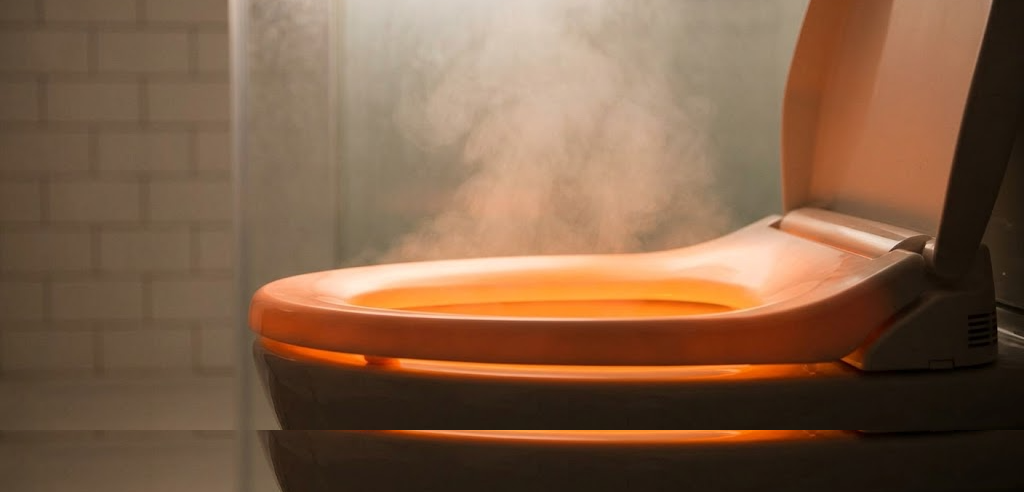
Heated Toilet Seats: What to Know Before You Buy
Spring is when most bathroom remodels get serious. The weather breaks, contractors open up, and that upgrade you have been
reads wrong when the choice is off. Get the mirror right, and the bathroom looks resolved. Get it wrong, and no amount of tile or fixture selection compensates for a shape or finish that doesn’t belong.
Large mirrors, broadly, anything that spans more than two-thirds of the vanity width or runs floor to ceiling, have become the dominant choice in contemporary bathroom design. But “large mirror” covers a lot of ground. A frameless full-wall panel and an oversized ornate Venetian mirror are both large. They have almost nothing else in common.
This guide covers what’s working in bathroom mirror design right now, what has run its course, and how to choose the right mirror for your specific bathroom.
The trend toward oversized bathroom mirrors has been consistent for several years and shows no sign of reversing. More than 62% of new construction projects have seen an increase in average mirror size compared to five years ago. In renovation design, large mirrors are now the default starting point rather than a design statement.
The reasons are both practical and aesthetic. A large mirror reflects more light back into the room, meaningful in bathrooms where natural light is limited. In a bathroom with a single window, a large mirror positioned opposite or adjacent to the light source effectively doubles the perceived brightness. In bathrooms under 80 square feet, a mirror that spans most of the vanity width makes the space read as significantly larger than it measures.
But within the category of large mirrors, the specific shapes, finishes, and configurations that are currently working have narrowed considerably. Size is the direction; the specific choices within it are what this guide is about.
If you are looking for a stylish addition to your bathroom, here are the large bathroom mirrors that are in style currently:
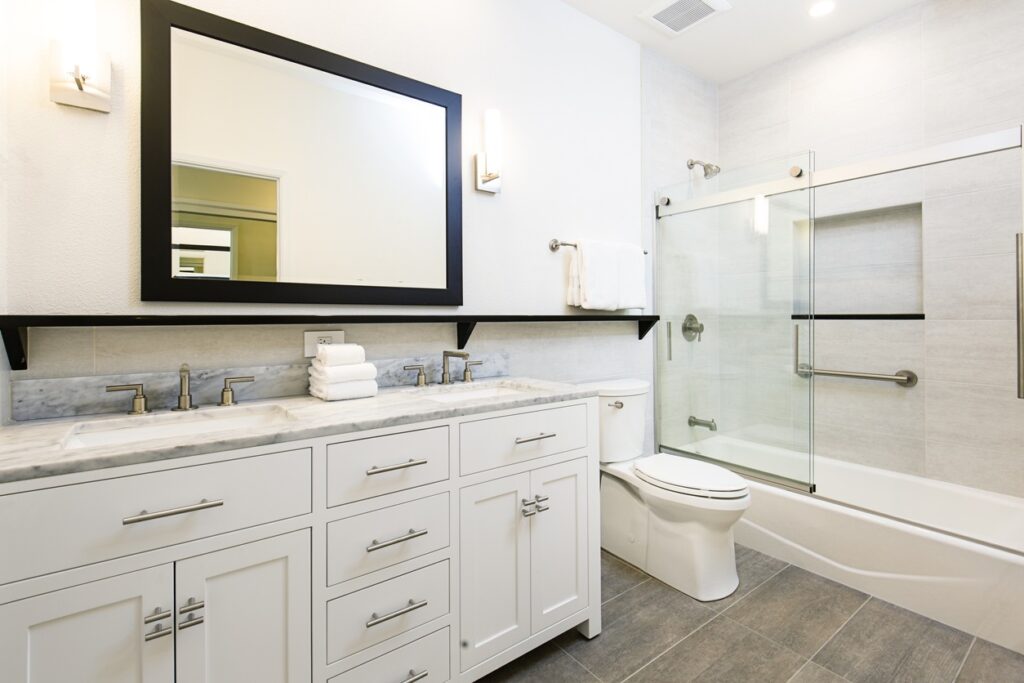
Circular remains a staple of both modern and classic design. However, a large circular mirror can create a more relaxing aesthetic and is certainly not a trend that will go out of style anytime soon.
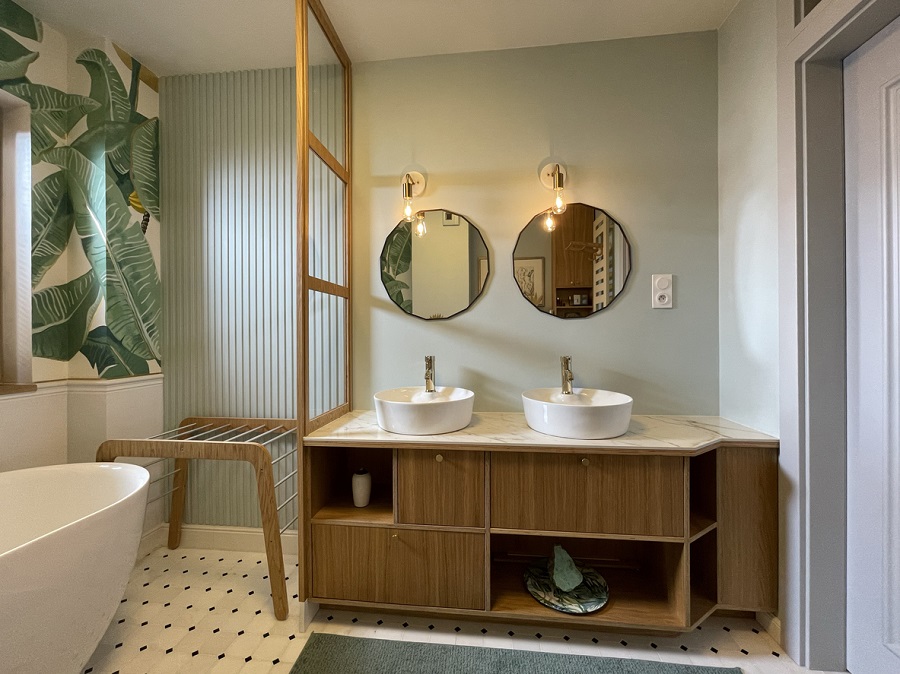
Organic, curved, and arched shapes are the most visible current direction in bathroom mirror design. Soft arches, rounded corners, and irregular organic outlines have replaced the previous default of hard rectangular frames. Designers consistently describe curved mirrors as adding warmth and movement to spaces dominated by hard surfaces – tile, stone, glass, metal. A single arched mirror above a vanity reads as a considered design choice in a way that a standard rectangle no longer does. For bathrooms with warm material palettes (wood vanities, stone tile, brass fixtures), a curved mirror is the natural match.
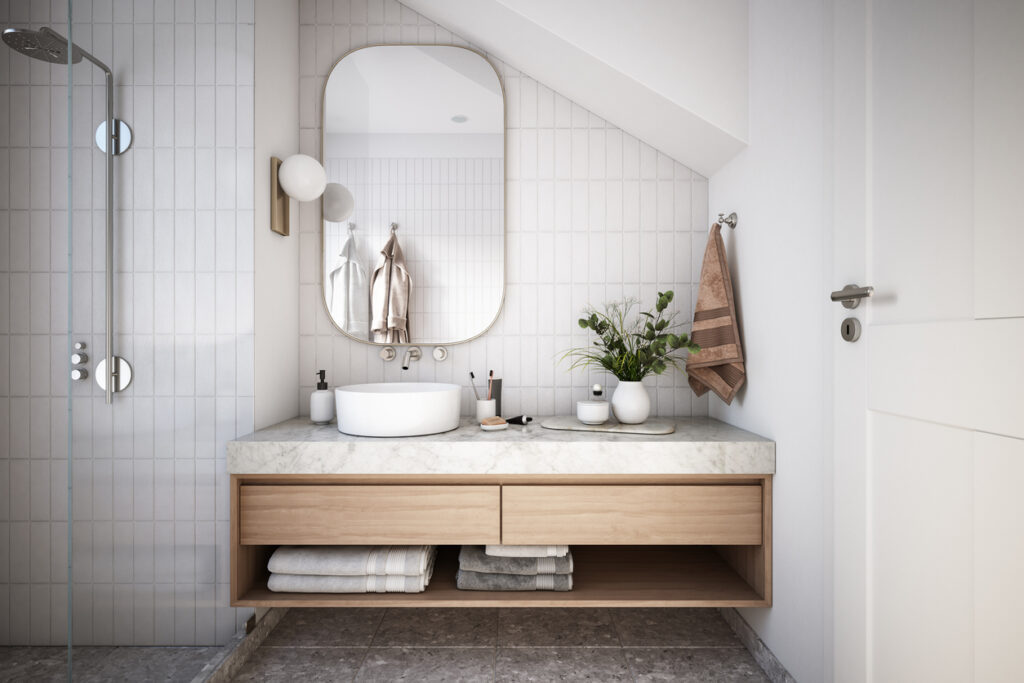
Arched mirrors with iron edging are versatile with any color scheme. However, keep in mind that the mirror can be pretty heavy and is not suitable for hanging.
Organic, curved, and arched shapes are the most visible current direction in bathroom mirror design. Soft arches, rounded corners, and irregular organic outlines have replaced the previous default of hard rectangular frames. Designers consistently describe curved mirrors as adding warmth and movement to spaces dominated by hard surfaces – tile, stone, glass, metal. A single arched mirror above a vanity reads as a considered design choice in a way that a standard rectangle no longer does. For bathrooms with warm material palettes (wood vanities, stone tile, brass fixtures), a curved mirror is the natural match.
Frameless oversized panels remain a strong choice for minimalist and contemporary bathrooms. A frameless mirror that spans the full width of the vanity – or extends a few inches beyond it on each side – creates an uninterrupted reflective surface that opens the room visually. The absence of a frame means the mirror doesn’t compete with other design elements. Works best in bathrooms where strong tile or material work is carrying the visual weight and the mirror’s job is to reflect and expand rather than decorate.
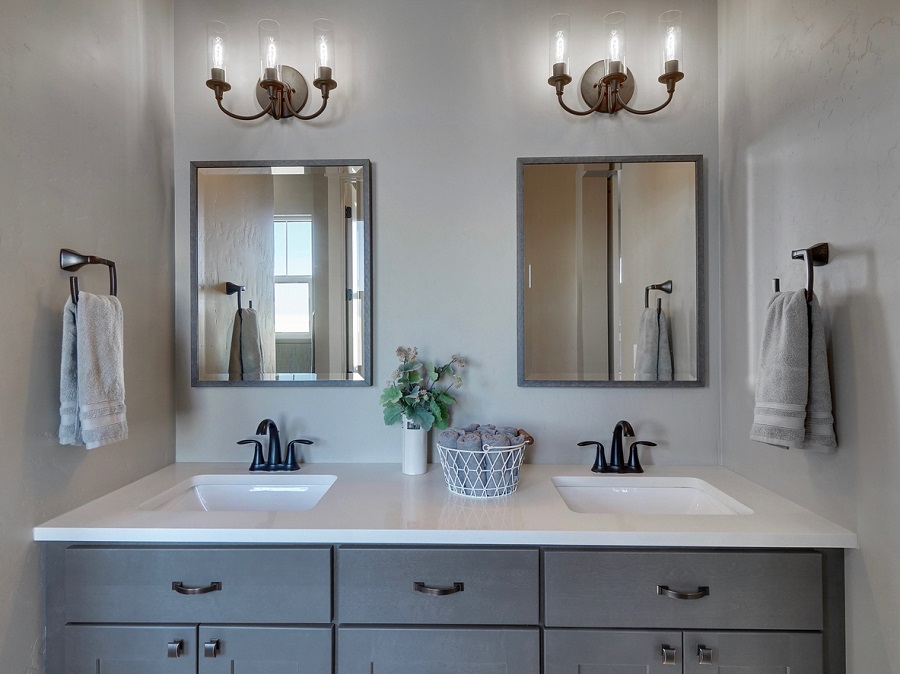
Double mirrors for double vanities address the design problem that a single large mirror creates over a shared vanity: it doesn’t anchor either sink individually. Two coordinated mirrors – matching in style or intentionally varied in a complementary way – create visual symmetry that reads as deliberate. The space between them accommodates a sconce, a shelving element, or simply breathing room.
Backlit and LED-integrated mirrors have moved from premium-market-only to mainstream. LED mirrors provide diffuse, shadowless illumination that is more flattering than overhead lighting alone, particularly for grooming tasks. Most quality LED mirrors allow adjustment of color temperature (warm vs. cool) and brightness, and include anti-fog as a standard feature. For a bathroom without a dedicated vanity sconce, a backlit mirror resolves the lighting and mirror decisions simultaneously.

Venetian mirrors provide vintage and classic aesthetic to any space. While it isn’t suited for every bathroom, the classic style can add a hint of refinement to any bathroom.
Hanging mirrors remain popular because they are easy to install and blend well with many different color schemes. Instead of having one large, stationary mirror, you have multiple mirrors that can be placed anywhere in your bathroom.
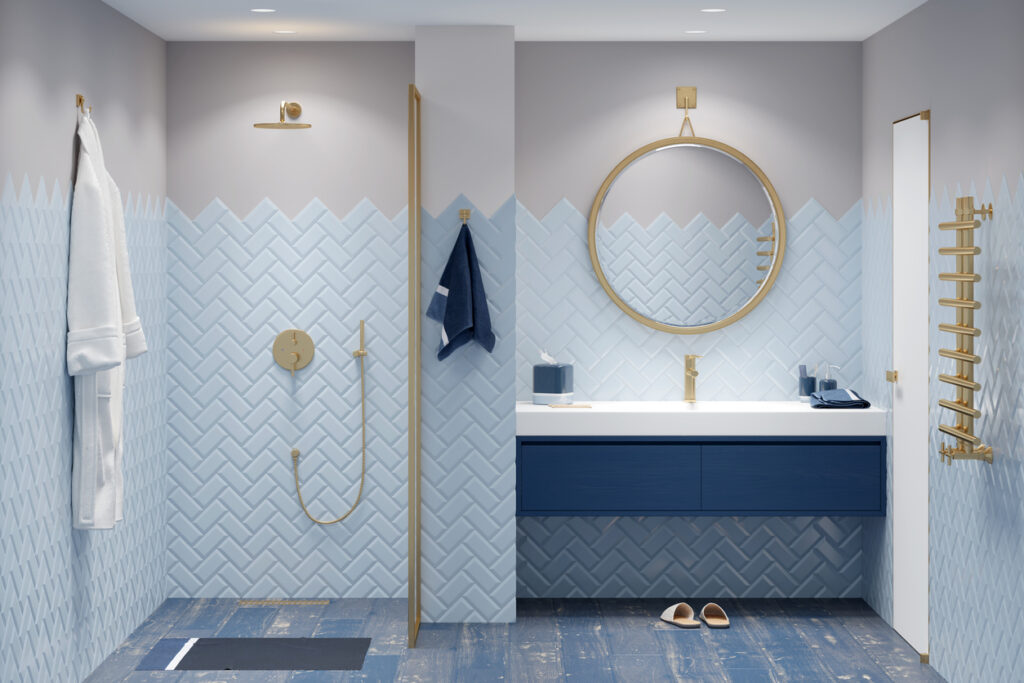
Finally, brass-framed mirrors are back in style! These mirrors are both elegant and stylish and are a great statement for any bathroom. Not to mention that the gold color will look good on white, beige, or patterned wallpapers.
You’ve probably seen them already but didn’t know their name! Concave mirrors are a type of spherical mirrors that are curved towards the mirror like a spoon. Because of this, concave mirrors seem larger than they are and are a great solution for bathrooms of all sizes.
Who is happy that functionality is coming back as a trend in 2024? After seeing Instagram-like bathrooms for years, we’re relieved that functionality is becoming a priority. Adding a mirror to your cabinets is a practical trick, giving your bathroom space structure and order. Instead of having products lying around, you can hide them all in the cabinet, and take them out only when needed.
As with all fashion, eventually, some mirrors fall out of favor due to their impracticality or design. Here are some mirrors that simply aren’t in style anymore:
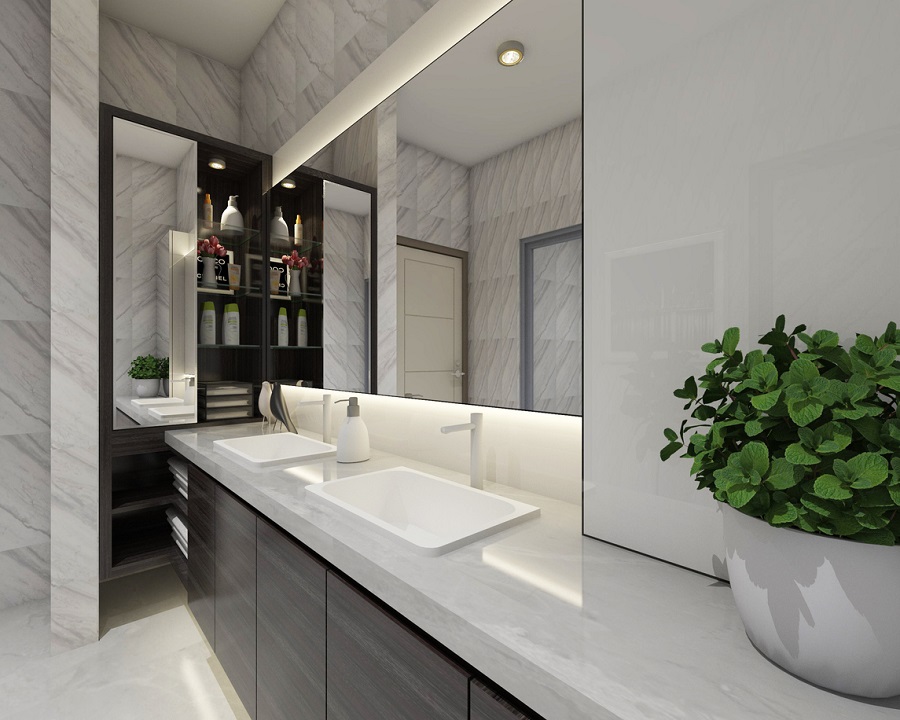
The full-wall mirror installations using small mirrored tiles or panels with visible joints that were common in the 1970s and 1980s – are a different thing from the full-wall frameless panels described in the previous section. The mirror tile wall is busy, high-maintenance (every joint and seam accumulates residue), and expensive to replace when individual mirrors crack. A single large frameless panel covering most of a wall is a contemporary design choice. A grid of small mirrored tiles with visible joints is not.
Oval mirrors had a moment, but the moment has passed. Oval occupies an awkward middle ground: it is neither the confident circle (which reads intentional and works across many contexts) nor the expressive organic curves that define current mirror trends. It is the shape that feels indecisive – neither decisively geometric nor expressive enough to be sculptural. New ovals installed now will require replacement sooner rather than later as the shape continues to date.
Bordered mirrors with decorative angled cuts around the perimeter – became ubiquitous in the 1980s and 1990s and have never recovered from that association. The bevel-strip aesthetic conflicts with every current direction in bathroom design: it is neither clean-lined nor organic, neither genuinely contemporary nor genuinely traditional. It is the mirror equivalent of brass builder hardware from the same era. If the existing bathroom has a bevel-strip mirror, replacing it is one of the highest-impact, lowest-cost design upgrades available.
Of course, the choice of your bathroom mirror will depend on your preferences, but you shouldn’t ignore your bathroom size, design, and potential.
When it comes to different bathroom mirror types, keep these things in mind:
Once you have an idea of which bathroom mirror you would like to add to your bathroom, there are a few things you will need to keep in mind:

A 48-inch frameless mirror weighs between 40 and 80 pounds depending on glass thickness. A full-wall panel spanning 72 inches or more can weigh 100-200 pounds. These are not installations for drywall anchors alone.
For any mirror over 30 inches in either dimension: confirm that the wall has blocking – horizontal wood framing installed between studs – at the mounting location. Blocking distributes the load properly and is required for heavy mirrors. If blocking wasn’t installed during the rough-in, address it during the renovation before walls are closed. Adding blocking after walls are finished requires opening the wall.
For LED mirrors: a dedicated outlet or wired connection at the back of the mirror location should be part of the electrical rough-in. Running a cord from an LED mirror to a nearby outlet is workable but leaves the cord visible unless it is recessed into the wall.
Large mirrors go up last in the renovation sequence – after tile is complete, paint is dry, and fixtures are installed. Installing a heavy mirror before the bathroom is otherwise finished increases the risk of damage during remaining work.
A bathroom renovation is finished when the mirror goes up. Every decision made before — tile, vanity, fixtures, lighting — reads differently against the mirror background.
The practical consequence: choose the mirror before finalizing the vanity and fixture finishes. The relationships between elements matter more than any individual choice. A brushed brass mirror frame with chrome faucets reads as mismatched. A black matte frame with warm wood cabinetry requires intentional pairing. A frameless panel works in more finish combinations than any framed option.
Make the mirror decision early, let it inform the palette of the rest of the room, and install it last. That sequence produces bathrooms that look designed, not assembled.

Eric is the founder and president of Badeloft USA. He has been the president of Badeloft’s US division for over ten years and oversees all marketing and branding aspects of Badeloftusa.com.
His expertise lies in small business development, sales, and home and bathroom industry trends and information.
Contact us with any business related inquiries.
Badeloft is dedicated to helping homeowners make informed decisions about their bathrooms. We adhere to strict editorial guidelines to ensure our content is accurate, trustworthy, and useful.
Request free stone resin and stainless steel material samples. Delivered to your door.
Spring is when most bathroom remodels get serious. The weather breaks, contractors open up, and that upgrade you have been
A Japanese soaking tub, known traditionally as an ofuro, is designed for one purpose: full-body immersion. Unlike Western bathtubs built
Spring is peak bathroom renovation season – and with remodel costs up 15–20% this year, the pressure to get it
It’s spring, tax refunds are landing, and if you’ve been putting off a bathroom upgrade, you’re in good company. A
Request your free material sample below. By submitting, you agree to receive occasional product updates and offers from Badeloft. Unsubscribe anytime.
"*" indicates required fields