
Bathroom Tile Trends 2026: What’s Worth It, What Will Date Your Space, and What Changes When You Have a Freestanding Tub
If you’re mid-renovation or about to start one, you’ve probably spent more time than you expected staring at tile samples.
The short answer is no; bathrooms are not legally required to have a window. What they are required to have is ventilation, which a window can provide, but so can a properly sized exhaust fan.
Where it gets complicated is the building code question. Most states have specific rules on what constitutes adequate ventilation, and some jurisdictions explicitly prefer natural ventilation through a window. If you’re renovating, adding a new bathroom, or selling a home with a windowless bath, knowing your state’s code matters more than the general debate about windows.
This guide covers the building code requirements by state, the practical benefits a window provides beyond ventilation, what window type actually works best in a bathroom, and how to properly ventilate and light a bathroom that doesn’t have one.
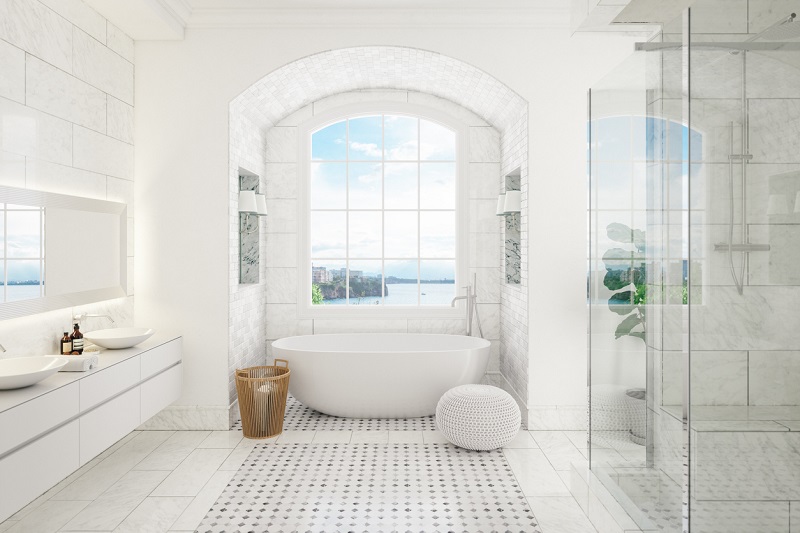
Below are a few of the benefits that installing a window can bring to your bathroom:
Bathrooms naturally attract moisture and with poor ventilation, they can grow mild and mildew in their damp environment. Mold and mildew is a result of the moisture in a given area being trapped in a space. Without treatment, this mold can grow to damage floors and walls of your bathroom if you aren’t careful. A window helps provide proper air circulation so that moisture is less likely to build up and the excess moisture can be vented out of your bathroom.

As stated previously, mold and mildew can grow as a result of condensation and excess moisture in your bathroom. A window or even multiple windows can help reduce condensation that may cloud up your shower doors or your bathroom mirror. While it may not be as dangerous as mold or mildew, condensation can be quite annoying to deal with especially if it obscures your mirror and any glass for a long period of time.
Bacteria grows as a result of excess moisture in addition to a warm environment, making your shower and bathroom an ideal environment. While you can’t exactly control the overall temperature of your bathroom, you can certainly control the moisture level to an extent. Having proper air ventilation will prevent bacteria growth and help to keep your bathroom a safe area for both you and your family.
When doing any remodeling work on your house, it is key that you follow city codes and laws, otherwise you will face fines and will be forced to re-do or demolish any existing work that has been done.
Under section 1203.4.2.1, California’s building code requires that any bathroom that contains a bathtub, shower, spa or similar, will require ventilation by an exhaust fan. In a similar vein, under section 1203, any property designed for occupation must be naturally ventilated by windows, doors and other openings. These openings must be at least 4 percent of the occupied floor area.
Texas bathrooms require that an exhaust fan must be installed in each full bath and must be energy star qualified. If an operable window is present, then an exhaust fan is not required. All fans need to vent out to the exterior, be mechanically fastened and sealed with duct mastic, insulated to R-6 and have a mechanical damper installed. Lastly, laminated or tempered safety glass is required for any glass that is within five feet of any bathtub, shower drain or pool vicinity.
New York requires that all water-closet compartments, bathrooms, and general public toilet rooms require at least one window opening upon a street, lawful court, yard or space above a setback. These windows must be at least three square feet in area and must be made so that half it’s area can be readily opened. A window is not required if one of these rooms is located at the top story or underneath the bottom of a court that is also lighted and well ventilated by a roof that can also be regularly opened. If a window is not installed, a New York bathroom requires a ventilation system that has been approved by the associated department.
Florida residents are not required to have a window in their bathroom. If they do have windows installed however, they are required to be impact resistant, which includes safety glazing or tempered glass.
For residents in New Jersey, windows must be made of tempered glass and bathrooms must provide an aggregate glazing area in windows of no less than three square feet that must be able to open. If a window is not provided, a mechanical ventilation system must be installed, circulating air directly to the outside.
A bathroom in Ontario is not required to have a window, but still requires some form of an exhaust fan and a ventilation system that leads to the outside and away from the building.
In addition to providing better ventilation for your bathroom, windows can provide your bathroom with more natural light without any additional cost.
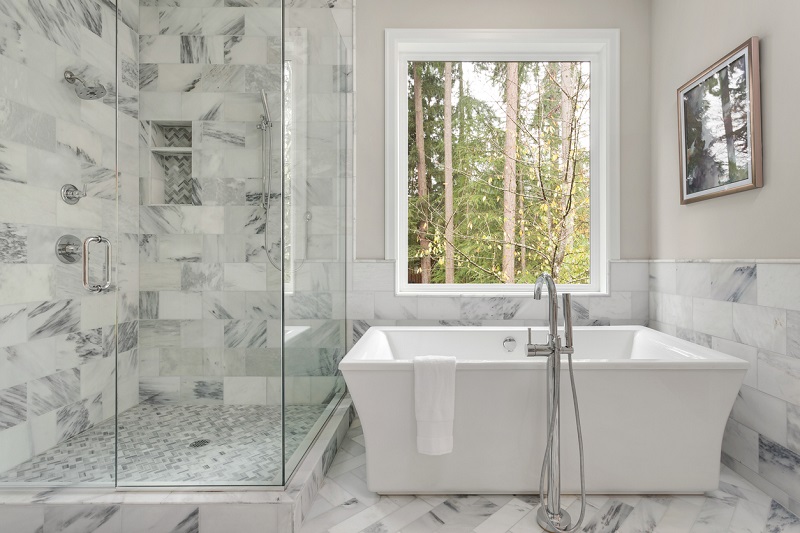
Lack of windows means that you have fewer ways of bringing in cooler air into your bathroom, especially on hot days, making it very unpleasant for your guests.
Windows drastically improve the resale value of your property due to the benefits they bring to any home. Lack of windows in a property requires future additions to the home which no potential buyer really wants to go through. Typically, more windows means your property will be much more popular than a property with less windows.

A vent will always solve the problem of not having a window in your bathroom. The primary aspect of both is to recirculate moisture and air from the outside into your home then expel it back outside. For any bathroom or home, you need an air system that can recirculate through your home for both sanitary and aesthetic needs. The only drawback to relying on a ventilation system only is that your bathroom will see a lack of natural lighting.
bathroom needs at least 40 CFM; a 5×10 needs 50 CFM. Most building codes require a minimum of 50 CFM for bathrooms with tubs or showers.
Inline fans: For bathrooms in interior walls where ducting to an exterior is complicated, an inline fan mounted in the attic or ceiling cavity handles the exhaust run without noise in the bathroom itself.
HRV and ERV systems: If the home has a whole-house mechanical ventilation system (heat recovery ventilator or energy recovery ventilator), an interior bathroom can tie into that system and meet code without a window or dedicated exhaust fan.
Dehumidifiers: A bathroom dehumidifier won’t satisfy code on its own, but paired with an exhaust fan, it substantially reduces residual moisture between uses in a space that gets heavy steam exposure.
The practical reality: A well-sized exhaust fan running during and 20 minutes after a shower does most of what a window does for moisture and air quality. The things a fan cannot replicate are natural light and the visual spaciousness a window adds.
Not all window styles are equally suited to a bathroom. The wet environment, privacy requirements, and the need for controlled ventilation make some options clearly better than others.
Awning windows (top recommendation for shower-adjacent placement)
Awning windows are hinged at the top and swing open from the bottom. This means you can leave them open during rain without water coming in, and they ventilate while angled away from direct splash. They’re the most practical choice for a window positioned near or above a shower. Available in frosted glass for privacy.
Double-hung windows allow you to open the top sash, the bottom sash, or both. Opening the top sash alone lets hot, humid air escape near the ceiling while keeping the lower portion closed for privacy. Best for windows positioned above eye level on an exterior wall away from the shower.
Casement windows crank open fully, giving maximum airflow from a single window. They work well above a vanity or on an end wall where they’re not directly exposed to shower spray.
A fixed picture window doesn’t open, so it provides no ventilation — but it delivers significant natural light. Pair one with a properly sized exhaust fan. Good choice for a window positioned over a soaking tub where privacy glass or high placement handles the discretion concern.
Frosted glass (etched or laminated) provides permanent privacy while still passing light. Clear glass with a window film is a DIY alternative that can be reversed. For windows on street-facing walls, consider obscure patterned glass that diffuses the view from outside completely while still brightening the room.
The most common reason homeowners skip a bathroom window is privacy. There are four practical solutions, each with different cost and permanence:
Frosted or etched glass: The cleanest solution. Obscures visibility from outside while transmitting light. Available in partial frost (lower half only) or full-panel. Best applied during window selection, not retrofit.
Frosted window film: A DIY option that applies directly to existing clear glass. Costs $20–$60 for a standard bathroom window. Removable and repositionable. Effective for diffusing visibility without eliminating light. Quality varies — static-cling films are easier to apply but less durable than adhesive versions.
High placement: A window positioned above the eye line of anyone standing outside provides functional privacy without any treatment. Works best when the bathroom has enough ceiling height to place the window 5.5 feet or higher on the wall.
Top-down/bottom-up shades: A cellular or Roman shade on a top-down/bottom-up track lets you cover the lower half for privacy while leaving the upper half open for light and ventilation. More expensive than film but adjustable and aesthetically clean.
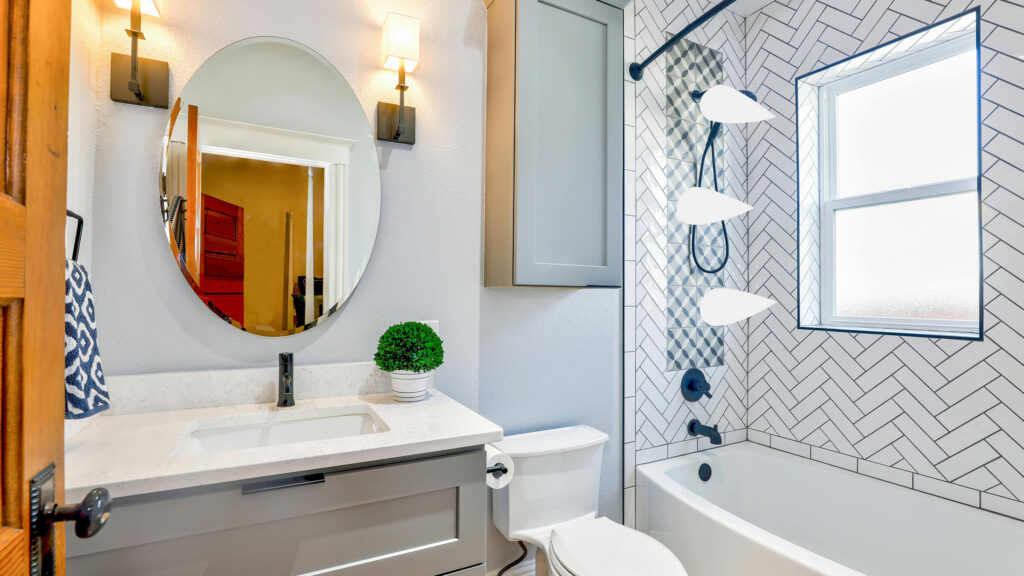
If your bathroom currently has no window and you’re renovating, the answer depends on what you’re trying to solve.
For moisture control, A properly sized exhaust fan handles the ventilation requirement. You don’t need a window to prevent mold if the fan runs consistently and the bathroom is vented to the exterior (not just into a wall cavity or attic).
For natural light: No exhaust fan replicates what a window does here. If the bathroom feels dark and closed, a window is the only real fix.
For code compliance: Check your state’s requirements before assuming you’re fine. Several states have specific thresholds for natural ventilation that a fan alone doesn’t satisfy when a window is available as an alternative.
For resale: In a buyer’s market, a completely interior windowless bathroom is a visible negative, especially in a primary or guest bath. In a tight market, it rarely kills a deal, but it limits your ceiling.
If adding a window isn’t structurally feasible (interior bathroom with no exterior wall), a solar tube or light tube is a partial alternative , it delivers daylight through a reflective tube from the roof to a ceiling diffuser. Not a substitute for ventilation, but it addresses the light issue in a way a light fixture can’t.

Eric is the founder and president of Badeloft USA. He has been the president of Badeloft’s US division for over ten years and oversees all marketing and branding aspects of Badeloftusa.com.
His expertise lies in small business development, sales, and home and bathroom industry trends and information.
Contact us with any business related inquiries.
Badeloft is dedicated to helping homeowners make informed decisions about their bathrooms. We adhere to strict editorial guidelines to ensure our content is accurate, trustworthy, and useful.
Request free stone resin and stainless steel material samples. Delivered to your door.
If you’re mid-renovation or about to start one, you’ve probably spent more time than you expected staring at tile samples.
Getting the drain size wrong on a freestanding bathtub is one of those installation mistakes you don’t discover until the
Bathroom storage fails the same way every time: it gets planned last. By the time the tiles are in and
A waterfall faucet is one of the most visually compelling fixtures a bathroom can have. It’s also one of the
Request your free material sample below. By submitting, you agree to receive occasional product updates and offers from Badeloft. Unsubscribe anytime.
"*" indicates required fields