
Bathtub Drain Sizes: A Complete Guide for Freestanding and Standard Tubs
Getting the drain size wrong on a freestanding bathtub is one of those installation mistakes you don’t discover until the
Getting the drain size wrong on a freestanding bathtub is one of those installation mistakes you don’t discover until the water is already running or until a plumber quotes you a return visit to fix work you thought was done.
At Badeloft, we manufacture stone resin freestanding tubs and field drain sizing questions regularly: from customers who assumed what worked in their old alcove tub would carry over, and from contractors installing a freestanding model in a space designed for a different kind of plumbing. The questions tend to be the same, and the gaps in what’s available to answer them tend to be the same too.
Both the foundational sizing standards that apply to any residential tub and the specifics that change when you’re installing a freestanding model, particularly a deeper stone resin tub, are covered here in full.
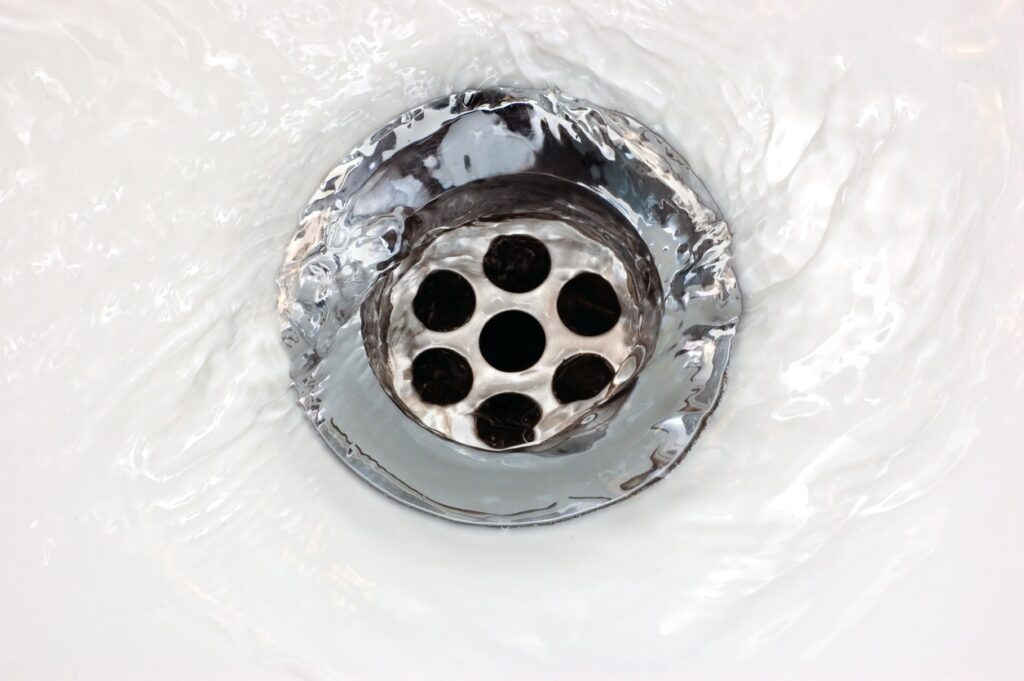
If you’re replacing a standard alcove tub with a freestanding and aren’t sure whether the drain size changes, this guide is for you. Maybe you’ve already ordered the tub and are trying to figure out the drain configuration before the plumber arrives. Or you’re a contractor who has installed hundreds of alcove tubs and is working with a premium freestanding model for the first time.
By the end, you’ll know the standard drain size, what actually changes for freestanding tubs, how to measure accurately, and what to confirm with your plumber before installation day. No expensive surprises and no return visits.
We’ll cover the standard size and where the nuance lives, what specifically changes for freestanding installations, how to measure in four steps, which drain size applies to which tub type, what “universal” drains actually mean in practice, what happens when you get it wrong, and what Badeloft’s own drain specifications look like.
So, let’s start with the number you’ll see everywhere and why it’s a starting point rather than a complete answer.
The standard bathtub drain pipe diameter in the United States is 1.5 inches. This applies to the majority of residential tubs: alcove, drop-in, freestanding, and clawfoot. It’s what you’ll find as the default at any plumbing supply store, it’s what the International Plumbing Code (IPC) establishes as the minimum for a bathtub drain line, and it’s what most tub manufacturers design to as a baseline.
That number, though, refers to the drain pipe diameter, the opening in the subfloor that connects to the home’s waste stack. The drain flange opening at the tub floor (the part you can see) is slightly larger. Standard tub drain flanges are sized to fit a 1.5-inch pipe, but the flange itself typically has an outside diameter of 1.75 to 1.875 inches. When people reference replacing a drain or ordering a drain kit, “1.5-inch” refers to the pipe size, not the flange opening.
For most standard residential installations, 1.5-inch handles normal use without issue. The nuance enters when the tub is deeper, holds significantly more water, or is designed with faster drainage as a requirement. Deep soaking freestanding tubs fall squarely into that category.
Note: this guide focuses on drain sizing. For a full breakdown of drain assembly components stopper types, waste-and-overflow assemblies, finish options see our drain assembly buying guide, which covers those decisions in depth.
A standard alcove tub holds roughly 40 to 60 gallons and drains through a 1.5-inch pipe at approximately 25 to 30 gallons per minute. For that volume, 1.5 inches is adequate.
A large freestanding soaking tub, particularly a stone resin model in the 70-inch range, holds 65 to 90 gallons. That additional volume isn’t the only factor. Deep soaking tubs hold more water under pressure from greater column height, which increases the velocity and demand on the drain system at the moment of emptying. For this reason, many freestanding tub manufacturers, including Badeloft , specify a 2-inch drain pipe for larger and deeper models. A 2-inch drain doesn’t just flow faster; it reduces the risk of gurgling, back pressure, and slow drainage that can result when 80 gallons tries to exit through a pipe sized for 50.
Three other things change for freestanding installations specifically:
Drain elevation and shoe length. In an alcove tub, the drain connects almost flush with the subfloor in a recessed cavity. A freestanding tub sits on feet or a continuous base, elevated above the floor. The horizontal drain shoe (the pipe running from the drain flange to the P-trap below the floor) needs to bridge that elevated distance. Drain shoe lengths for freestanding tubs are typically longer than for alcove tubs, and the assembly needs to be confirmed against the specific tub’s underside clearance.
Overflow placement and height. In an alcove tub, the overflow sits on the end wall of the surround. In a freestanding tub, the overflow is on the tub body itself, set into the interior wall near the head end. For deeper soaking models, the overflow is positioned higher on the tub wall to permit a deeper fill. Some Badeloft models have overflow openings 17 to 22 inches above the tub floor. The drain assembly’s overflow tube must match this distance exactly, a mismatch at either end creates a gap that will leak under water pressure.
Drain access. For alcove tubs built into a surround, the plumber can access the drain connection through an access panel behind the end wall. For freestanding tubs, access is from below, through a crawl space, basement, or trap door in the subfloor. If that access doesn’t exist before the tub is placed, creating it after is a significantly larger project. This is worth confirming with your contractor before the tub is delivered.
Whether you’re replacing an existing drain or sizing a new installation, four measurements determine the correct drain assembly. Write these down before ordering anything or calling a plumber.
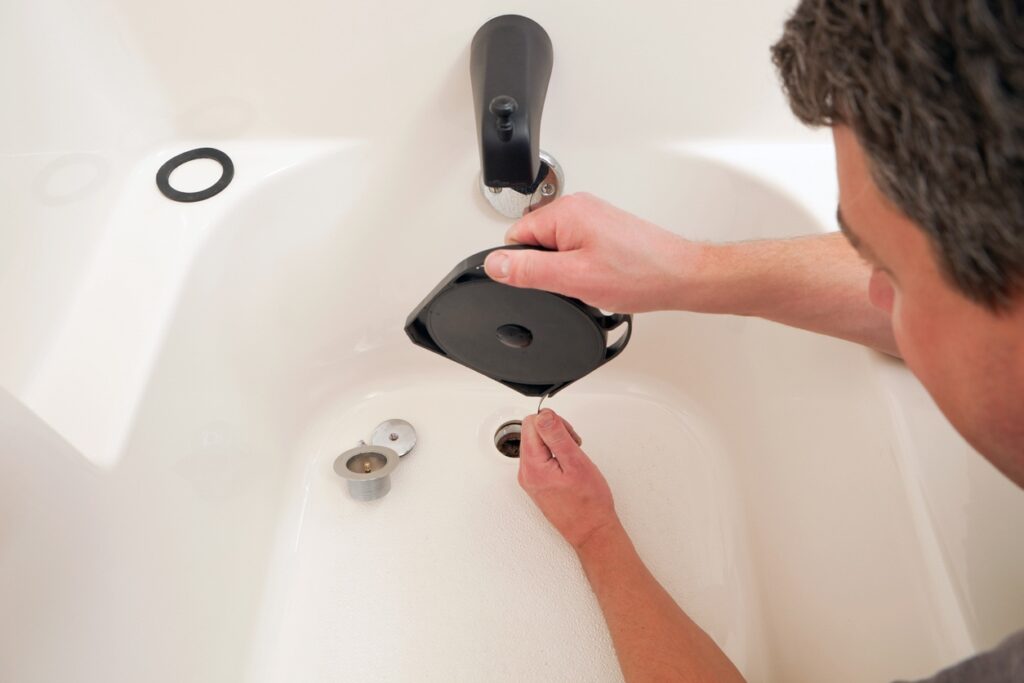
Step 1: Drain hole diameter. Measure the diameter of the opening at the tub floor. Most standard tubs have a 1.75 to 1.875-inch flange opening. Measure the hole itself, not any existing drain flange that may be sitting in it.
Step 2: Drain shoe length (waste arm length). This is the horizontal distance from the center of the drain opening at the tub floor to the center of the overflow opening on the tub wall. It determines the length of the waste arm in the drain assembly. For alcove tubs, this typically runs 10 to 14 inches. For freestanding tubs with different drain and overflow positions, this measurement varies and must be confirmed from the tub’s spec sheet.
Step 3: Overflow depth (overflow-to-drain distance). This is the vertical distance from the center of the drain opening at the tub floor to the center of the overflow opening on the tub wall. Standard alcove tubs have overflow depths of 14 to 16 inches. Deep soaking freestanding tubs typically measure 17 to 22 inches. This number determines the length of the overflow tube in the drain assembly. It is the measurement most commonly overlooked and the one most responsible for installation mismatches.
Step 4: Tub height (exterior floor to rim). Combined with the overflow depth, this tells you how much fill is possible before the overflow activates. A 24-inch tub with an overflow at 17 inches fills 17 inches of water depth. A 24-inch tub with an overflow at 21 inches fills 21 inches before overflow activation, a meaningful difference for deep soaking.
These four measurements are your complete sizing picture. The tub’s installation guide and technical spec sheet will include all four for the specific model you’re installing.
| Tub Type | Recommended Drain Pipe Size | Notes |
|---|---|---|
| Standard alcove (40–60 gal) | 1.5″ | IPC minimum, adequate for standard volume and fill cycles |
| Freestanding soaking, under 65″ (under 65 gal) | 1.5″ or 2″ | Check manufacturer spec; 2″ preferable if tub exceeds 60 gallons |
| Freestanding soaking, 66″+ (70–90 gal) | 2″ | Recommended for larger volume and deeper fill; Badeloft standard for 66″+ models |
| Whirlpool / jetted tub | 2″ | Faster drainage required to prevent stagnant water in jet lines |
| Walk-in tub | 2″ | Some models use dual-drain systems; confirm manufacturer spec |
| Clawfoot tub | 1.5″ | Exposed drain; uses standard compression or twist-lock fittings |
| Japanese soaking tub (ofuro) | 2″ | High water column from steep soaking depth increases drain demand |
| Corner tub / drop-in (over 70 gal) | 2″ | Volume-driven; confirm against tub capacity before specifying |
Most buyers focus on the main drain opening at the tub floor. The overflow drain receives less attention, but it’s directly connected to the sizing equation, literally and figuratively.
The overflow is the safety drain positioned on the interior wall of the tub, typically 14 to 22 inches above the tub floor depending on the model. Its job is to prevent the tub from overflowing onto the bathroom floor if the tap is left running. It connects via an overflow tube (part of the drain assembly) down to the same P-trap as the main drain.
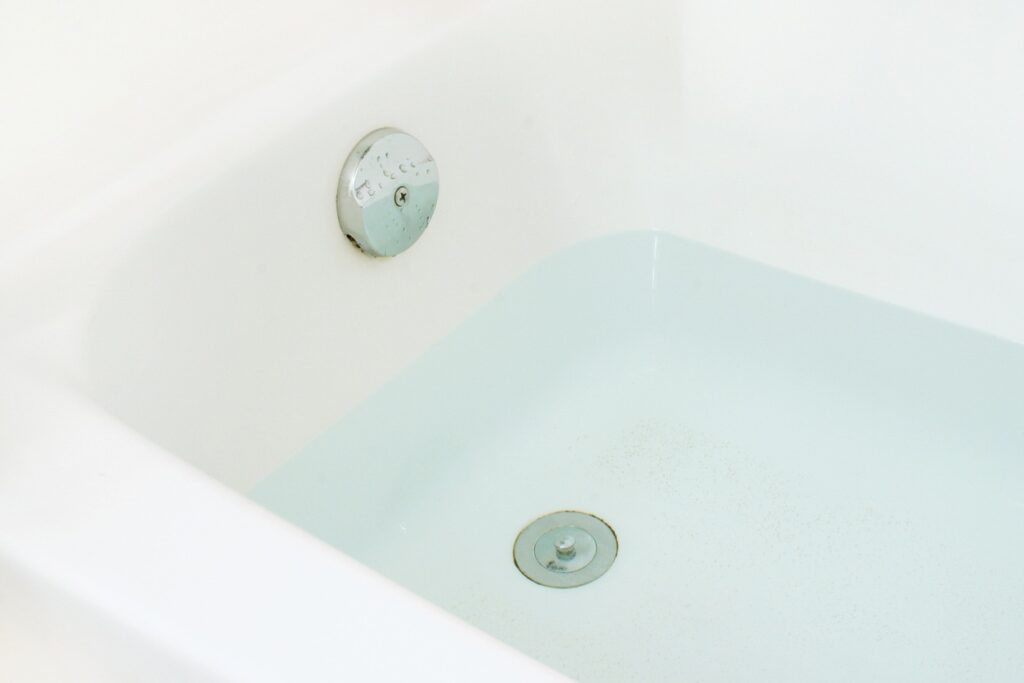
For freestanding tubs, both the main drain and the overflow connect through a single drain assembly that passes through the floor to the P-trap below. The vertical distance between the two connection points, overflow center to drain center, determines the overflow tube length required. Getting this measurement wrong by even an inch or two creates a gap at one connection, which leaks under water pressure. The leak typically doesn’t show up in the tub; it shows up in the ceiling below the bathroom or behind a wall, after weeks of slow accumulation.
Standard overflow-to-drain distance for alcove tubs: 14 to 16 inches.
Standard overflow-to-drain distance for freestanding soaking tubs: 17 to 22 inches, depending on soaking depth.
Badeloft’s deeper models have overflow placements in the upper range of this span. Always confirm the overflow-to-drain distance from the technical spec sheet for the specific model being installed, and match it against the drain assembly tube length before ordering.
If your tub’s manufacturer specifies 2-inch, that’s the answer. Confirm the subfloor drain pipe matches and proceed accordingly. Upgrading from 1.5-inch pipe to 2-inch at the subfloor level is a plumbing modification, not a hardware swap. It typically means replacing the P-trap and the section of waste pipe running to the stack, and potentially the stack connection depending on how the home was plumbed.
Even where the manufacturer doesn’t specify 2-inch as a requirement, upsizing is worth considering in any of these situations:
The tub holds more than 70 gallons. A 1.5-inch pipe will drain it, but slowly. Slower drainage increases the rate at which soap, oils, and mineral deposits build up inside the waste pipe over time.
The home’s waste system has reduced flow from age or partial blockage. Upsizing the tub drain gives the system additional clearance to compensate for what the rest of the stack may lack.
The tub includes jets or a hydrotherapy system. Jet systems require faster drainage at the end of each use to prevent stagnant water from sitting in the lines between baths.
The renovation budget has room for it. The incremental cost of specifying 2-inch during a bathroom renovation is low. The cost of returning to upsize after the tub is installed is not. If the conditions are borderline, sizing up during the original installation is the lower-cost decision over the life of the fixture.
“Universal” bathtub drains are designed to fit the most common configurations: 1.5-inch pipe openings, standard flange diameters, and overflow depths of 14 to 16 inches. They work reliably for the vast majority of standard alcove tub replacements. In that context, “universal” is an accurate description.
For freestanding tubs, the term breaks down in predictable places:
For any Badeloft model, we recommend against universal drain assemblies. Order a drain assembly matched specifically to the tub’s overflow depth measurement. The cost difference between a correctly specified assembly and a universal one is typically under $30. The cost of a reinstallation after a mismatch is not.
Most guides move past this quickly. The failure modes are specific and worth knowing in advance because they inform how seriously to treat the measurement steps above.
Drain pipe too small for tub volume: Slow drainage after every bath. Water pools at the foot end while the drain catches up. Over time, scale, oils, and soap residue accumulate faster in a consistently slow-draining pipe, increasing maintenance frequency and eventual blockage risk.
Overflow tube too short for the tub’s overflow depth: The connection between the overflow body and the drain shoe doesn’t seal under water pressure. The leak doesn’t appear in the tub; it appears below the floor, often in a ceiling or wall cavity, after weeks of slow accumulation. By the time it’s visible, the damage to subfloor framing or ceiling material has already happened.
Overflow depth mismatched to tub design: If the overflow tube is too short and terminates lower on the tub wall than designed, the overflow activates early limiting usable fill depth. For a 24-inch deep soaking tub, an overflow that activates at 14 inches instead of 20 inches means 6 fewer inches of soaking depth every time. That’s a significant reduction in the tub’s primary purpose.
Upsizing the drain without matching the subfloor pipe: A 2-inch drain assembly connected to a 1.5-inch waste line via a reducer fitting doesn’t deliver 2-inch drainage performance. The flow bottleneck is below the floor. Money was spent on the wider assembly without gaining the drainage benefit.
None of these are unfixable. All of them are avoidable with accurate measurements and a short conversation with the plumber before the tub arrives.
All Badeloft stone resin freestanding tubs are designed for a drain flange opening of 1.75 inches at the tub floor. Drain pipe specifications by size category are as follows:
| Model Category | Exterior Length | Recommended Drain Pipe | Overflow Depth |
|---|---|---|---|
| Small models (BW-01-S, BW-02-S) | Under 60″ | 1.5″ acceptable; 2″ preferred | Confirm from spec sheet |
| Medium models (BW-02-M, BW-03-M, BW-10-M) | 62–64″ | 2″ recommended | Confirm from spec sheet |
| Large models (BW-01-L, BW-02-L, BW-03-L, BW-04-XL, BW-10-L, BW-12) | 66–68″ | 2″ required | Confirm from spec sheet |
| XL models (BW-01-XL, BW-02-XL, BW-03-XL, BW-05-XL, BW-10-XL) | 70–73″ | 2″ required | Confirm from spec sheet; typically 17–21″ depending on soaking depth |
| BW-01-XXL (side-by-side model) | 74.8″ x 47.2″ | 2″ required | Confirm from spec sheet |
| BW-11 (wide oval) | 68.9″ | 2″ required | Confirm from spec sheet |
The exact overflow-to-drain measurement for each model is included in the technical documentation shipped with every Badeloft tub. Confirm that measurement against your drain assembly’s tube length before installation. If you’re ordering a drain assembly separately, provide the overflow-to-drain measurement, not just the drain pipe size when specifying the assembly.
Drain finish options for Badeloft models include chrome, brushed nickel, matte black, and brushed gold. The drain finish should match the tub faucet finish for a visually consistent installation.
Installation day goes smoothly when these five items are confirmed in advance. Most plumbers appreciate having this information before they arrive rather than discovering it on site.
These five confirmations take 15 minutes over the phone before the tub arrives and routinely prevent the most common installation callbacks.
If you’re working through a freestanding tub selection and want to confirm drain specs for a specific Badeloft model, our team can provide exact measurements for any model in our lineup. Every tub ships with a full technical installation guide. If drain assembly selection is still a question, our drain assembly buying guide covers stopper types, materials, and hardware finishes in full.

Eric is the founder and president of Badeloft USA. He has been the president of Badeloft’s US division for over ten years and oversees all marketing and branding aspects of Badeloftusa.com.
His expertise lies in small business development, sales, and home and bathroom industry trends and information.
Contact us with any business related inquiries.
Badeloft is dedicated to helping homeowners make informed decisions about their bathrooms. We adhere to strict editorial guidelines to ensure our content is accurate, trustworthy, and useful.
Request free stone resin and stainless steel material samples. Delivered to your door.
Getting the drain size wrong on a freestanding bathtub is one of those installation mistakes you don’t discover until the
Bathroom storage fails the same way every time: it gets planned last. By the time the tiles are in and
A waterfall faucet is one of the most visually compelling fixtures a bathroom can have. It’s also one of the
Choosing a bathtub color is one of the few bathroom decisions you’ll live with for 15 to 20 years. Get
Request your free material sample below. By submitting, you agree to receive occasional product updates and offers from Badeloft. Unsubscribe anytime.
"*" indicates required fields