
Why Homeowners Are Rethinking the Traditional Tub-Shower Setup in 2026
The modern residential landscape is currently undergoing a profound architectural and psychological shift, moving away from the utilitarian “all-in-one” bathroom
The modern residential landscape is currently undergoing a profound architectural and psychological shift, moving away from the utilitarian “all-in-one” bathroom solutions of the late 20th century toward a more segmented, luxury-oriented configuration. As homeowners increasingly view their properties not just as shelters but as holistic wellness hubs, the demand for separate bathtub and shower installations has reached an unprecedented peak. This trend is driven by a convergence of economic factors, such as the “stay-in-place” economy, and deeply personal motivations rooted in health, aesthetics, and long-term property value.”
The primary driver for the modern bathroom remodel is no longer simple maintenance; it is the pursuit of a “spa-like” retreat within the home. According to the 2025 Houzz Bathroom Trends Study, 25% of renovating homeowners specifically cite “rest and relaxation” as the primary use for their new bathroom, while 24% use the space for “beauty and pampering.” This shift in perspective has fundamentally changed how space is allocated. When the tub and shower are combined, neither can fully realize its potential as a wellness tool. By separating them, homeowners can optimize the shower for its invigorating, high-tech capabilities and the bathtub for its restorative, meditative qualities.
Bill Darcy, the Global President and CEO of NKBA, observes that the bathroom is evolving into a sanctuary in response to the stresses of modern life, stating that “thoughtful design elements such as ease of maintenance, optimal lighting, and integrated smart technology empower homeowners to craft spaces that not only restore the body and mind but also elevate their sense of well-being.” This “sanctuary effect” is backed by the fact that 90% of homeowners now want their primary bath to serve as a retreat from the outside world.
| Priority | Percentage of Respondents |
|---|---|
| Primary bath as a “retreat from the outside world” | 90% |
| Focus on health and wellness as a design driver | 79% |
| Inspired by hotel and resort experiences | 77% |
| Preference for “relaxed/retreat-like” themes | 66% |
| Preference for “spa-like” themes | 64% |
This move toward a “wellness-centered footprint” is reflected in the physical expansion of the room. Nearly 72% of designers agree that the overall footprint of the bathroom is increasing to accommodate these purpose-built spaces. When space is expanded, the freestanding bathtub often becomes the “focal point” of the entire suite, a visual anchor that signals the room’s purpose as a place of rest.
From a financial perspective, the inclusion of both a dedicated shower and a bathtub is a strategic play to maximize a home’s appeal across the widest possible range of potential buyers. Real estate experts and appraisers often view a home with at least one dedicated tub and one dedicated shower as the “sweet spot” for marketability. Jonathan J. Miller, a prominent home appraiser and president of Miller Samuel, categorizes the bathtub as a “commodity” in a house, noting that “sellers who have the most commodities—or amenities—win because their houses appeal to the widest audience and you’re always trying to expand the buyer pie.”
Data from the NAHB confirms that this configuration is a top priority for first-time buyers, with 72% rating the presence of both a shower stall and a tub in the primary bath as either “essential” or “desirable.” While the ROI for an upscale remodel involving high-end freestanding tubs is mathematically lower than a basic midrange refresh, the impact on time on market and perceived value can be significant. A bathtub’s “emotional” value—the lifestyle it promises—often reduces the time a home spends on the market, an equity aspect that isn’t always captured in a formal appraisal but is deeply felt during the selling process.
| Data Point | Figure |
|---|---|
| First-time buyers rating separate tub/shower as “essential” | 72% |
| Prospective buyers desiring a “full bath” on the main level | 80% |
| Average ROI for midrange bathroom remodel | 80% |
| Average ROI for upscale remodel (with freestanding tubs) | 42% |
| Percentage of sellers who improve bathrooms before listing | 29% |
For luxury markets, the expectation is even higher. High-end buyers generally consider a five-piece bathroom (double sink, toilet, walk-in shower, and separate tub) as the standard for a “complete bathroom suite.” Removing a tub to create a larger shower can actually cause a home’s value to take a hit if it results in the property having no bathtubs at all, as this alienates families with small children.
Accessibility is no longer a niche concern; it has become a defining priority in modern remodeling. As the population ages, homeowners are designing spaces that can accommodate their needs five or ten years down the line. A separate tub and shower layout is the most effective way to future-proof a home. This setup allows for a low-curb or curbless shower—which 52% of homeowners now prioritize for easier entry—while still retaining a tub for those who enjoy or require immersion bathing.
Universal design principles prioritize “flexibility in use,” and the dual-fixture layout provides exactly that. For older adults or those with mobility challenges, a walk-in shower is a practical and safe choice, reducing the risk of falls associated with stepping over high tub walls. Simultaneously, many seniors find that a deep soak in a tub provides essential relief for joint pain and arthritis. By separating the fixtures, a homeowner doesn’t have to choose between a safe daily shower and a therapeutic bath.
| Feature | Percentage of Remodelers |
|---|---|
| Low-curb or curbless showers | 52%–66% |
| Nonslip flooring | 55% |
| Grab bars | 61%–65% |
| Shower benches or integrated seating | 79% |
| Extra lighting for hazard detection | 31% |
Marine Sargsyan, a Houzz staff economist, highlights this demographic shift, noting that homeowners are “increasingly working with professionals to integrate features that make their bathrooms safer, more adaptable and more supportive for all household members now and into the future.” The separate configuration ensures that the bathroom remains functional for a toddler, a busy professional, and an aging grandparent all at once.
One of the most compelling reasons homeowners are returning to the bathtub is the growing body of scientific evidence supporting the health benefits of immersion bathing. Research indicates that the physiological effects of sitting in a warm tub are vastly different from—and often superior to—those of standing in a shower. Cross-sectional studies have reported better subjective health status for those with a regular habit of immersion bathing, with significantly lower scores for fatigue, stress, and pain.
The mechanism behind this is “hyperthermic action,” which increases blood flow and metabolic waste elimination through the gentle pressure and heat of the water. For the modern workforce—where approximately 80% of adults will experience back pain and 78% report feeling chronic stress—the tub serves as a non-pharmacological treatment for daily ailments. The ability to submerge the body fully washes away the tension of the workday in a way that a quick shower cannot.
| Health Outcome | Bathing Score (Mean) | Showering Score (Mean) |
|---|---|---|
| Tension-Anxiety | 43.7 | 46.5 |
| Depression-Dejection | 47.5 | 49.6 |
| Anger-Hostility | 46.9 | 50.0 |
| Stress/Fatigue Reduction | Significant Improvement | Minimal Improvement |
Furthermore, the separate tub plays a critical role in sleep hygiene. Taking a hot bath one to two hours before bed can help individuals sleep longer and more deeply by signaling the body to wind down and helping regulate core temperature. This bedtime ritual is much more effective in a dedicated, deep-soaking tub where the user can fully relax without the psychological “rush” often associated with showering.
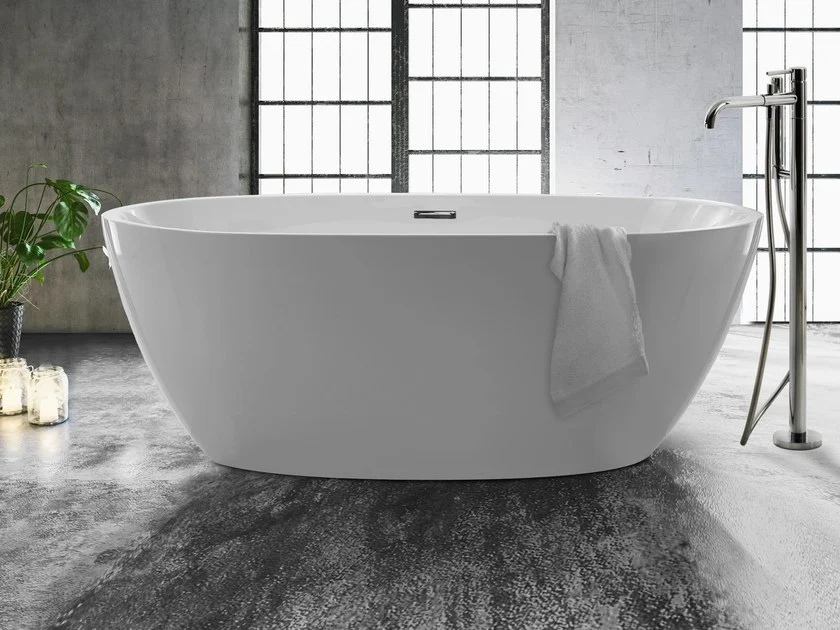
In the world of interior design, the bathtub has evolved from a hidden utility to a visually striking centerpiece. Homeowners love separate tubs because they act as a statement piece that dictates the character and mood of the entire room. Freestanding models, such as those manufactured by Badeloft, offer a level of sculptural appeal that built-in units simply cannot match. They provide tremendous flexibility in placement, allowing the tub to be framed by windows, centered in the room, or tucked into a cozy alcove.
Designers often use the separate tub to create visual balance in the space. For example, placing a rounded, smooth-form tub between dual vanities can soften the sleek cabinetry and geometric tile of the rest of the room, creating an atmosphere of quiet luxury. This aesthetic appeal is a major factor in joy scores. After completing a bathroom upgrade, homeowners report a joy score of 9.6 to 9.8 out of 10, largely driven by the beauty and aesthetics of their new fixtures.
| Design | Design Theme | Key Visual Feature |
|---|---|---|
| Minimalist Oval | Contemporary/Zen | Clean lines, versatile for most styles |
| Vintage Clawfoot | Victorian/Farmhouse | Iconic feet, adds antique charm |
| Rectangular/Boxy | Modern/Industrial | Confident, bold design statement |
| Slipper/Asymmetrical | High-End Spa | Ergonomic curves, sculptural focus |
| Matte Black/Stone | Daring/Luxe | Bold color, organic texture |
By decoupling the tub from the shower, homeowners can also avoid the clunky look of fiberglass shower-tub combos from the 1980s, which real estate agents say can make a bathroom look like a “large, clunky renovation project” to potential buyers. A separate, high-quality tub communicates that the home is a high-end property.
The practicality of a separate tub remains a cornerstone for family life. For those with young children, a bathtub is not a luxury—it is a safety necessity. Bathing a toddler in a walk-in shower is physically demanding and often ineffective, whereas a tub provides a safe and convenient way for parents to bathe their children. Real estate experts note that families will often rule out a house specifically for this reason if it lacks at least one tub.
However, as the household matures, the separate shower becomes the workhorse of the home. Busy professionals and teens value the speed and convenience of a dedicated shower stall. By having both fixtures, the bathroom adapts to the lifestyle of the inhabitants now and in the future. This is particularly true in multi-generational living situations, where seniors may need the accessibility of a walk-in shower while younger family members still utilize the tub.
| Household Need | Recommended Fixture | Primary Benefit |
|---|---|---|
| Families with young kids | Bathtub | Safe, easy containment for washing |
| Busy professionals | Separate Shower | Efficiency, morning speed |
| Athletes/Active adults | Soaking Tub | Muscle recovery, pain relief |
| Pet owners | Bathtub | Easier to wash small/medium animals |
| Seniors | Curbless Shower | Safety, mobility, fall prevention |
Even the two-person bathing ritual is cited as a benefit for modern couples. A large, freestanding tub offers an intimate and indulgent ritual that enhances connection and promotes well-being. It allows couples to unplug and unwind together, turning an evening into a spa-worthy escape without leaving the house.
Interestingly, many homeowners prefer separate fixtures for reasons of pure hygiene and low-fuss maintenance. While having two separate units means more surfaces to clean overall, there is a psychological and practical upside. Dedicated bath takers often dislike the idea of sitting in a tub that is also used as a daily shower floor, where “shower ick”—soap scum, hair, and body oils—tends to accumulate more rapidly.
A separate tub remains a pristine environment, used only for soaking. Modern materials like nonporous high-tech polymer (acrylic) are increasingly popular because they are stain-resistant, exceptionally easy to clean, and prevent mold growth. Furthermore, the move toward wet rooms simplifies the cleaning process even further. In a wet room, the tub and shower are located within the same waterproof enclosure, allowing for large-format tiles and minimal grout lines that can be sprayed down quickly.
| Maintenance Factor | Benefit of Separate Layout | Key Material/Feature |
|---|---|---|
| Surface Hygiene | No “shower ick” on the tub floor | Nonporous Acrylic |
| Mold Prevention | Better air flow around separate units | Acrylic/Stone Resin |
| Cleaning Speed | Wet room allows for “hose down” | Large Format Tile |
| Long-term Durability | Tubs don’t see daily shower traffic | High-tech Polymers |
This focus on easy-to-clean yet stylish choices is a top trend for 2026. Homeowners are willing to spend more upfront to create a bathroom that is their own private getaway but doesn’t require hours of scrubbing. As the industry moves toward “minimalism matured,” the clean lines of a separate freestanding tub and a glass-enclosed shower deliver the visual calm that modern homeowners crave.
The “Great Re-Benchmarking” of the home remodeling market has revealed that Americans are spending more on their homes than ever before. Within this stay-in-place economy, the kitchen and bath sectors remain a powerhouse. Homeowners are no longer renovating solely for the next buyer; they are renovating for their own joy and wellness.
For companies like Badeloft USA, the data suggests that the freestanding tub is not just a trend but a fundamental shift in how people utilize their personal space. Whether it is a sculptural centerpiece in an expansive master suite or a Japanese-style soaking tub in a smaller urban bathroom, the desire for a dedicated place to soak is rooted in biology, economics, and design. As Bill Darcy of the NKBA summarizes, the bathroom has transitioned from “utility to sanctuary,” and the separate tub and shower configuration is the architectural manifestation of that journey.
By catering to these seven multi-dimensional needs, the dual-fixture bathroom layout has cemented its place as the premier choice for the modern American home.

Eric is the founder and president of Badeloft USA. He has been the president of Badeloft’s US division for over ten years and oversees all marketing and branding aspects of Badeloftusa.com.
His expertise lies in small business development, sales, and home and bathroom industry trends and information.
Contact us with any business related inquiries.
Badeloft is dedicated to helping homeowners make informed decisions about their bathrooms. We adhere to strict editorial guidelines to ensure our content is accurate, trustworthy, and useful.
Request free stone resin and stainless steel material samples. Delivered to your door.
The modern residential landscape is currently undergoing a profound architectural and psychological shift, moving away from the utilitarian “all-in-one” bathroom
Acrylic bathtubs have become one of the most widely used materials in modern bathrooms, offering a balance of affordability, comfort,
When you’re shopping for a freestanding bathtub, the material matters just as much as the shape or size. It changes
A well-designed bathroom begins long before fixtures are selected or materials are introduced. It starts with understanding the space itself.
Request your free material sample below. By submitting, you agree to receive occasional product updates and offers from Badeloft. Unsubscribe anytime.
"*" indicates required fields