
Bathroom Storage Trends 2026: The Planning Guide That Changes When You Choose a Freestanding Tub
Bathroom storage fails the same way every time: it gets planned last. By the time the tiles are in and
A waterfall faucet is one of the most visually compelling fixtures a bathroom can have. It’s also one of the most frequently regretted purchases when the wrong version ends up in the wrong room, too shallow a basin, too much water pressure, a finish that looks stunning in a product photo and collects scale in practice. The gap between what waterfall faucets promise and what a poorly matched one actually delivers is wider than most bathroom fixture decisions.
At Badeloft, we design and source premium bathroom fixtures such as freestanding tubs, faucets, and the complete systems that bring a bathroom together. We’ve seen which waterfall faucets hold up over years of daily use, which basin pairings work, and which installations become sources of recurring frustration. What follows is the assessment we’d give a client standing in the middle of a renovation, not a product description dressed up as a guide.
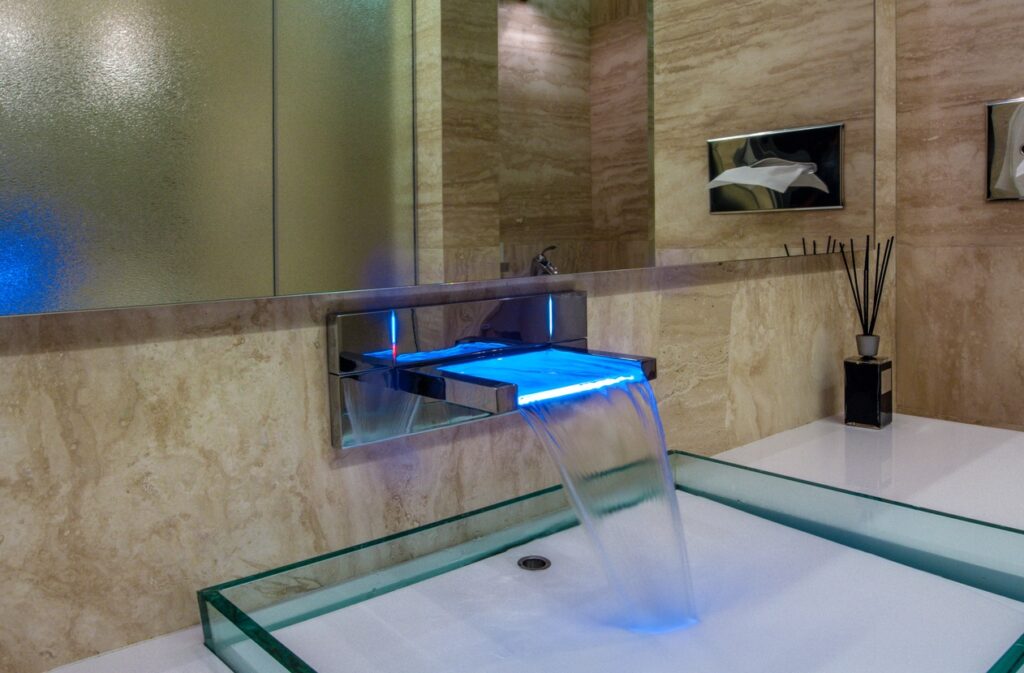
This covers both the genuine benefits and the honest drawbacks, including the compatibility factors most buyers discover only after the faucet is installed and the contractor is gone.
If you’re mid-renovation and a waterfall faucet is at the top of your wishlist, this gives you the framework to evaluate whether a specific faucet will actually work in your space. Maybe you’ve already installed one and are dealing with unexpected splashing or a maintenance routine you didn’t anticipate there are explanations for both, and solutions for most. Or you’re comparing fixtures at three different price points and wondering what actually separates them. The answer matters more than the price tag suggests.
By the end of this guide, you’ll know precisely which scenarios waterfall faucets excel in, which they don’t, and how to evaluate a specific model before committing. You won’t be guessing whether the faucet will work in your space.
We’ll cover the genuine strengths and where each one shows up in daily use, the real drawbacks (including the ones that rarely appear in reviews until after purchase), the basin and sink compatibility specifics that determine whether a faucet splashes or flows cleanly, and how waterfall design performs when the fixture is paired with a freestanding tub rather than a sink basin.
So, let’s start with what makes a waterfall faucet different in the first place because that difference determines everything that follows.
A waterfall faucet delivers water through a wide, open channel or spout rather than through a narrow aerator nozzle. The result is a broad, flat sheet of water that falls from the spout with minimal turbulence resembling, as the name suggests, a small waterfall rather than a pressurized stream.
The design originated from a specific aesthetic impulse: the spa bathroom. In high-end hospitality and residential design, the waterfall faucet became a visual signal of intent this bathroom was built for experience, not just function. The open spout, the wide flow, the sound of water falling rather than rushing: all of it communicates something a standard aerator faucet does not.
The structural difference also creates functional trade-offs that are worth understanding before any other evaluation. Because the spout is open and wide, the flow dynamics are entirely different from a traditional faucet. Water pressure, basin geometry, spout height, and sink depth all interact in ways they don’t with a conventional nozzle. Getting those variables right is the difference between a waterfall faucet that performs beautifully and one that splashes water onto your vanity every morning.
The benefits of waterfall faucets are real. They’re just more specific than most descriptions acknowledge — meaning they show up clearly in some contexts and barely at all in others.
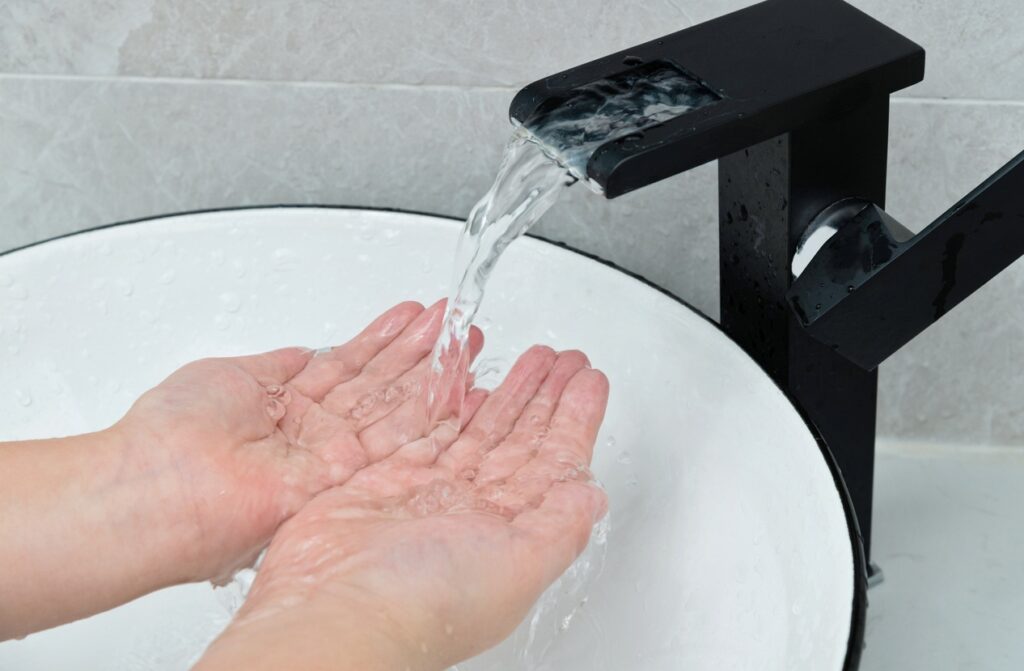
The visual and sensory effect of a waterfall faucet in the right bathroom is genuinely different from what a standard fixture offers. The wide, laminar flow has a calming quality that doesn’t come from aesthetics alone it’s also the sound. A waterfall faucet running at low to medium pressure produces a softer, more even sound than the rushing or spattering of an aerated faucet. In a bathroom designed for relaxation a soaking tub setup, a spa-style wet room, a primary bath with natural materials that difference is felt every time the faucet runs.
This isn’t a small thing in a space you use twice a day. The cumulative sensory experience of a well-designed bathroom is part of its value, and the faucet is one of the few elements in that space that produces both sound and movement. Waterfall faucets do both in a way that supports the intended ambiance rather than working against it.
At standard residential water pressure, a waterfall faucet runs quieter than a conventional nozzle faucet. The open-channel flow produces less turbulence at the spout exit point, which translates to less noise. For bathrooms where quieter operation matters — a shared wall with a bedroom, a child’s bathroom, an early-morning routine that shouldn’t wake anyone this is a functional benefit, not just an aesthetic one.
The caveat is pressure. At higher water pressure, waterfall faucets can become noisier and splashier. The quiet, laminar flow is a medium-pressure phenomenon. This is one of the reasons matching the faucet to your home’s actual water pressure is a step most buyers skip but shouldn’t.
Waterfall faucets are available across a wider design range than many buyers expect not just in contemporary or modern bathrooms, but in transitional, minimalist, and even traditionally influenced spaces depending on the specific fixture. Chrome, brushed nickel, matte black, brushed gold, and oil-rubbed bronze finishes are all widely available. Spout profiles range from angular and architectural to curved and organic.
This variety means a well-chosen waterfall faucet can work in a significant range of bathroom aesthetics it’s not a statement piece that demands a matching design language across the whole room. It does, however, tend to read best in bathrooms that have made deliberate choices about materials and finish, because the open spout draws the eye and holds it. In a bathroom where everything else is intentional, a waterfall faucet amplifies that. In a bathroom that’s still sorted out by default, it can look conspicuous rather than curated.
The exterior of most waterfall faucets has fewer joints, crevices, and hard-to-reach angles than traditional faucets with separate aerator assemblies, handle bases, and spout connection points. The result is a simpler exterior cleaning routine fewer places for soap scum, scale, and grime to accumulate and require effort to remove.
This advantage is real but comes with a counterbalancing maintenance requirement specific to waterfall designs: the open spout surface itself. More on that in the cons section but the net-net is that exterior cleaning is easier while spout maintenance requires more deliberate attention than a standard faucet demands.
Waterfall faucet drawbacks fall into two categories: the ones that are real but manageable with the right setup, and the ones that indicate this type of faucet is genuinely the wrong choice for a particular situation. The distinction matters because most reviews don’t make it — they list all drawbacks at equal weight and leave the buyer without a useful framework for deciding.
This is the most commonly reported post-purchase frustration, and it’s almost entirely a preventable installation problem rather than an inherent flaw. Waterfall faucets produce a wide, flat sheet of water that falls from the spout to the basin. When that fall is too high, the water spreads on impact and generates splash. When the basin is too shallow, that splash clears the rim. When the basin is flat-bottomed rather than angled, the water hits a horizontal surface and disperses laterally.
The result, in the wrong pairing, is water on the counter, the mirror, and sometimes the floor every time the faucet runs. This is not an overstatement. It’s the specific complaint that dominates one-star reviews of waterfall faucets that are, objectively, functioning exactly as designed.
Verdict: manageable with the right basin pairing. Dealbreaker only if you’re installing into a shallow, flat-bottomed sink with a fixed, high-spout faucet and no intention of changing either. More on the specific compatibility framework in a dedicated section below.
Waterfall faucets typically operate at flow rates between 1.5 and 2.2 gallons per minute (gpm). Many traditional aerated faucets operate at 2.2 gpm or above, and high-flow models can go higher. For sink use, this difference is negligible you’re filling a small basin or rinsing your hands, not waiting meaningfully longer either way.
For tub fillers, it matters more. A waterfall-style tub filler at 2.0 gpm filling a 60-gallon freestanding soaking tub takes roughly 30 minutes. A high-flow traditional tub filler at 4–6 gpm fills the same tub in 10–15 minutes. If filling time is a meaningful factor in your bathing routine, a traditional high-flow tub filler performs better regardless of aesthetics.
Verdict: not a dealbreaker for sink applications; worth considering seriously for tub filler applications if fill time is a priority.
Single-lever waterfall faucets, the most common design, adjust temperature through a rotational mixing valve that blends hot and cold proportionally to the handle position. In practice, fine-tuning to an exact temperature requires attention and can feel imprecise, particularly in older plumbing systems with variable pressure between the hot and cold supply lines.
The solution is a thermostatic cartridge or a thermostatic mixing valve, which maintains a preset temperature regardless of supply pressure variation. This is the configuration used in high-end hospitality bathrooms for exactly this reason. It costs more than a standard single-lever, but it eliminates the temperature inconsistency entirely.
If you run hot water for specific reasons, a warm morning rinse, a specific comfort preference — and precise temperature matters, look for waterfall faucets specifying thermostatic cartridge technology rather than standard ceramic disc mixing.
Verdict: manageable with the right cartridge selection. Relevant consideration for buyers with variable-pressure plumbing or strong temperature preferences.
The flat, open surface of a waterfall spout, the same feature that creates the laminar flow — is a surface that collects standing water after every use. In hard water regions, that means mineral deposits accumulate on the spout face continuously. In any bathroom, it means the spout needs regular wiping to prevent water staining, and in poorly ventilated bathrooms or in humid climates, the standing water creates conditions for mold growth in the channels.
This is not a theoretical concern it’s the specific maintenance issue that differentiates waterfall faucet ownership from traditional faucet ownership. A standard aerator faucet drains fully between uses. A waterfall spout does not.
The practical response is simple but requires consistency: wipe the spout dry after each use, or after the last use of the day. In hard water areas, a weekly white vinegar wipe-down prevents mineral accumulation from becoming an etching problem. This takes under thirty seconds once it’s a habit, but it is a habit that traditional faucets don’t require.
Verdict: manageable with a simple daily habit. Relevant dealbreaker consideration only for buyers who genuinely won’t maintain it — or for second bathrooms and guest baths that see irregular use and infrequent cleaning.
Waterfall faucets are available at virtually every price point, which creates a misleading impression that cost is not a meaningful barrier. The reality is that the quality threshold for a waterfall faucet that performs well solid brass construction, ceramic disc cartridge, quality finish adhesion, proper flow rate engineering, sits higher than the equivalent threshold for a conventional faucet.
A $60–80 conventional faucet is often serviceable. A $60–80 waterfall faucet is typically zinc alloy construction with a chrome layer over a material that will show wear within two to three years. The flat spout on that fixture is also more likely to cause splashing than an engineered version, because the flow geometry hasn’t been properly designed for laminar output.
The minimum investment for a waterfall faucet that doesn’t create regret is meaningfully higher than the minimum for a standard faucet. Budget accordingly, or wait until the budget allows for the right fixture rather than installing a version that teaches you what you should have bought.
Verdict: a real consideration, not a dealbreaker. The cost is justified if the rest of the bathroom is being built to a standard that matches it.
Waterfall faucets , particularly wall-mounted and widespread deck-mount configurations, may require plumbing rough-in adjustments that a direct swap of a standard faucet does not. The supply line spacing, the mounting hole configuration, and the water supply position relative to the spout height all need to align with the chosen faucet’s specifications.
For a straightforward single-hole deck-mount replacement, compatibility is usually not an issue. For wall-mounted waterfall faucets or those with non-standard spread, it requires either confirming your existing rough-in matches the faucet or budgeting for a plumber to adjust the supply lines. This is not complicated work, but it is additional work that isn’t always factored into the installation cost estimate.
Verdict: relevant for wall-mount and widespread configurations. Single-hole deck-mount replacements are generally straightforward.
Most waterfall faucet splashing problems are entirely predictable from three variables: spout height, basin depth, and basin geometry. Yet almost no retail guidance and none of the competing content on this topic gives buyers an actual framework for evaluating these variables. The result is that buyers choose a faucet they like visually, install it in whatever sink they have, and discover the problem only when the water hits the counter.
Here is the framework:
Spout height determines fall distance. A waterfall faucet with a 10–12 inch spout height over a shallow basin produces a long, unsupported fall. The water sheet destabilizes during the fall and spreads, creating significant splash on impact. The same spout height over a deep basin keeps that fall within the basin walls and contains the spread. As a working rule: the taller the spout, the deeper the basin needs to be.
Basin depth is the primary splash variable. For a standard waterfall faucet at typical residential water pressure, a basin depth of at least 5–6 inches provides adequate containment for a mid-height spout (6–8 inches). For taller spouts (10–12 inches), you want 7–8 inches of basin depth minimum. Vessel sinks designed specifically as waterfall pairings — deeper, typically 5–7 inches — address this directly. Shallow undermount sinks (4 inches or less) are the most problematic pairing.
Basin shape governs where the water goes after impact. A flat-bottomed basin directs impact water laterally — toward the rim and over it. A sloped or curved basin directs impact water toward the drain. This single variable accounts for a significant portion of the splashing complaints associated with waterfall faucets in otherwise adequate basin depths. If you’re choosing a sink to pair with a waterfall faucet, a curved or funnel-shaped basin bottom is the better choice over a flat one.
Before purchasing: measure your existing basin depth, note the basin bottom geometry, and compare both against the spout height specifications of the faucet you’re considering. Most product pages include spout height. Basin depth is almost always in the sink’s specification sheet. Thirty minutes of verification prevents a problem that is otherwise both predictable and entirely avoidable.
The waterfall faucet conversation almost always focuses on sink applications, bathroom vanity faucets, vessel sinks, deck-mount designs above a basin. But one of the most compelling and underserved applications is the waterfall tub filler paired with a freestanding soaking tub, and it changes the evaluation significantly.
In a freestanding tub context, most of the waterfall faucet’s traditional drawbacks either disappear or matter much less. Splashing is not a concern: the tub is deep, the walls are high, and the faucet is filling a vessel designed to hold 50–80 gallons. Basin geometry is a non-issue for the same reason. Cleaning the spout is simpler because the tub filler is a floor-mounted or wall-mounted fixture separate from a sink, typically in an open, easily accessible position.
What the waterfall faucet adds in this context is significant. Filling a freestanding soaking tub with a waterfall spout produces the sound and visual effect that the fixture’s design was built for, a broad sheet of water falling into a wide basin, audible from across the room, visually coherent with the premium investment the tub itself represents. A standard high-flow tub filler fills faster. A waterfall tub filler fills in a way that communicates intention that this bath is an experience, not a convenience.
The specific considerations for a waterfall tub filler:
At Badeloft, when clients ask us about pairing a faucet with a freestanding tub, the waterfall tub filler is a recommendation we make with confidence for the right installation. The combination works aesthetically in a way that’s qualitatively different from the same tub with a traditional floor-mount spout, and the practical drawbacks that apply to sink faucets are largely irrelevant in this context.
The material quality conversation around waterfall faucets is often flattened to “get brass, avoid zinc.” That’s true but not specific enough to be useful when you’re looking at product listings that don’t always volunteer this information clearly.
Here is what each common material actually means for ownership:
Solid brass is the benchmark for quality bathroom faucets. Brass is highly corrosion-resistant, machines to tight tolerances, and holds finish adhesion well over time. A solid brass waterfall faucet with a quality PVD (physical vapor deposition) finish is the correct choice for any bathroom intended to last 15–20 years without fixture replacement. It is also the most expensive option at the material level, and it shows up in the faucet’s price.
Stainless steel is an acceptable alternative for certain designs, particularly brushed and matte finishes that suit the material’s natural appearance. It is more resistant to surface scratching than brass and performs well in high-humidity environments. Its limitation is machinability: stainless steel is harder to machine to the tolerances that brass accommodates, which matters for cartridge seat geometry and long-term leak prevention.
Zinc alloy (zamak) is the material used in budget-tier faucets. It costs significantly less than brass, machines easily, and accepts chrome plating at low cost — which is why budget waterfall faucets often look nearly identical to brass ones in product photos. The practical difference shows up over 2–4 years: zinc alloy corrodes from the inside out in the presence of humidity and mineral exposure, the finish begins to pit and separate, and the fixture starts showing wear in a way that brass does not. A zinc alloy faucet in a bathroom that’s used daily should be considered a 3–5 year fixture, not a permanent installation.
How to identify the material when it’s not clearly labeled: weight is a reliable proxy, solid brass faucets are noticeably heavier than zinc alloy versions of similar size. Price is a secondary signal genuine solid brass construction below $120 for a full faucet assembly is unlikely. Any faucet described as “chrome-plated” without specifying the underlying material is almost certainly zinc alloy.
For the open spout geometry of a waterfall faucet, where the exposed surface area is larger and the maintenance requirements are higher, material quality is more consequential than it is for a traditional faucet. A zinc alloy open spout showing finish degradation looks worse than a traditional faucet showing the same wear, because there’s more of it visible. The upgrade to brass is worth it in this application specifically.
The standard conclusion to this kind of guide is “it depends on your priorities.” That’s accurate but not useful. Here is the direct version.
A waterfall faucet is the right choice if:
A waterfall faucet is probably the wrong choice if:
Waterfall faucets are genuinely beautiful fixtures that perform well in the right conditions. Those conditions are specific: an adequate basin depth, a quality material construction, a maintained spout surface, and a bathroom environment that matches their design register.
The most common regrets come from two places: installing a well-designed waterfall faucet in a basin it wasn’t suited for, and buying a low-cost version of a fixture that requires quality construction to perform. Both are avoidable problems.
The strongest application for a waterfall faucet, and the one where most of the drawbacks are irrelevant, is as a tub filler paired with a freestanding soaking tub. In that context, the design delivers exactly what it promises: the visual and sensory experience of water falling into a bath, in a space built to hold it.
If the conditions are right, it’s one of the most effective fixtures available for the experience of a premium bathroom. If they’re not, no aesthetic quality compensates for water on the vanity every morning.

Eric is the founder and president of Badeloft USA. He has been the president of Badeloft’s US division for over ten years and oversees all marketing and branding aspects of Badeloftusa.com.
His expertise lies in small business development, sales, and home and bathroom industry trends and information.
Contact us with any business related inquiries.
Badeloft is dedicated to helping homeowners make informed decisions about their bathrooms. We adhere to strict editorial guidelines to ensure our content is accurate, trustworthy, and useful.
Request free stone resin and stainless steel material samples. Delivered to your door.
Bathroom storage fails the same way every time: it gets planned last. By the time the tiles are in and
A waterfall faucet is one of the most visually compelling fixtures a bathroom can have. It’s also one of the
Choosing a bathtub color is one of the few bathroom decisions you’ll live with for 15 to 20 years. Get
Most bathtub decisions come down to what fits the space and what fits the budget. That is a reasonable starting
Request your free material sample below. By submitting, you agree to receive occasional product updates and offers from Badeloft. Unsubscribe anytime.
"*" indicates required fields