

Heated Toilet Seats: What to Know Before You Buy
Spring is when most bathroom remodels get serious. The weather breaks, contractors open up, and that upgrade you have been
Most homeowners searching this query are trying to answer one of three things: whether their contractor quote is in the right range, whether their budget is realistic for what they want, or whether a 5×10 bathroom is worth remodeling at all before selling.
The short answer on budget: a realistic mid-range 5×10 bathroom remodel runs $12,000 to $20,000 in 2026 when professionally executed. You can get it done for $6,000 to $10,000 if you DIY the cosmetic work and keep the plumbing in place. You can spend $30,000 or more if you move fixtures, add radiant flooring, or fully change the layout. This guide breaks down what each budget tier actually gets you and which costs tend to blow the budget unexpectedly.
| Remodel Component | Estimated Cost Range |
| Toilet | $150 – $600+ |
| Ventilation Fan | $200 – $500 |
| Lighting Fixtures | $350 – $1,200 |
| Sink | $350 – $900 |
| Bathroom Door | $400 – $800 |
| Replacement Windows | $400 – $800 |
| Shower | $1,200 – $5,000+ |
| Vanity | $500 – $3,500+ |
| Demolition & Removal | $500 – $2,000 |
| Plumbing & Electrical Updates | $800 – $3,000 |
| Wall Prep & Waterproofing | $1,000 – $2,500 |
| Painting (Professional) | $350 – $800 |
| Final Finishes (Mirrors, Décor) | $200 – $850 |
| Labor (Various Contractors) | $2,000 – $5,000+ |
A 5×10 or 50 square foot bathroom is a large space, usually designated for a master bathroom. The size of the space allows for multiple design choices, such as a shared half or ¾ bathroom, but most commonly, it is used as a full bathroom.
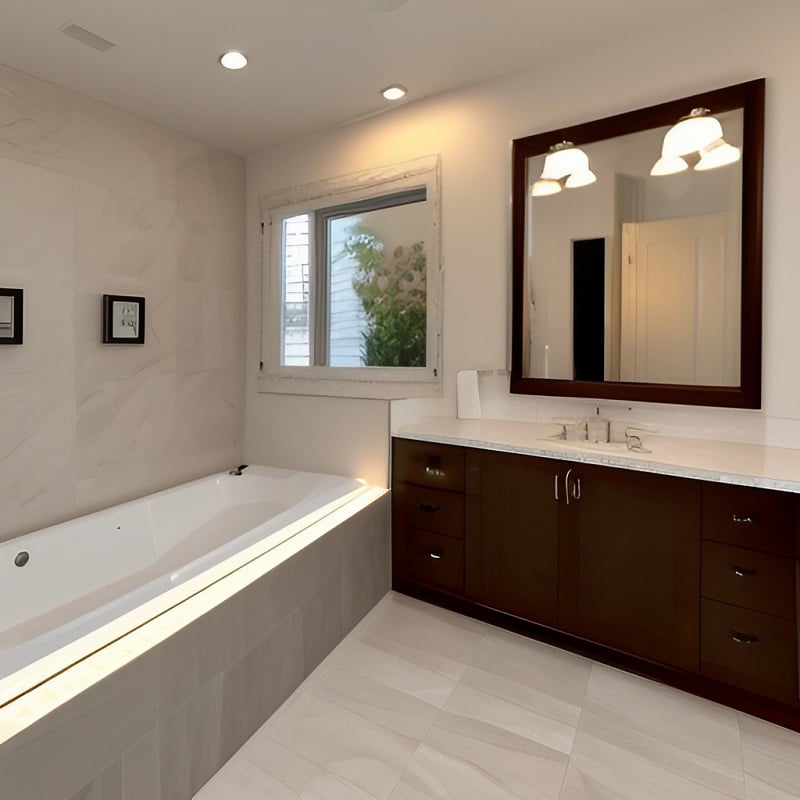
A well-executed remodel of a 5×10 bathroom can increase your home’s resale value by $13,000 to $20,000, depending on your local housing market. On average, homeowners recoup 60% to 70% of their investment. Use quality materials and create a modern, functional design. Your bathroom can also become a major selling point—helping your home stand out in a competitive real estate market.
While often used interchangeably, remodeling and renovating refer to two distinct approaches to updating a home.
Understanding the difference can help you better plan your project, set expectations, and choose the right professionals.
| Feature | Renovation | Remodel |
| Definition | Updates the appearance or repair of an existing space | Changes the layout, structure, or function of a space |
| Purpose | Refresh or restore | Transform or reconfigure |
| Examples | Replacing tile, repainting, upgrading fixtures | Moving walls, expanding layout, changing room purpose |
| Typical Cost | $3,000 – $15,000 | $8,000 – $30,000+ |
| Time Required | Shorter (1–2 weeks) | Longer (2–6 weeks or more depending on scope) |
| Permit Required? | Sometimes | Often required |
| Impact on Home Value | Moderate | Higher, especially if space is better utilized |
Who this is for: Homeowner doing significant DIY work, keeping the existing layout and plumbing in place.
What you get: New flooring (tile or LVP), fresh paint, updated light fixtures, new toilet, new vanity with sink, new faucet and hardware. Possibly a new shower surround if you use prefab panels rather than tile.
What you don’t get: New tub, tile work throughout, custom vanity, any plumbing moves, or permit-required structural changes.
Best used when: Selling the home and bringing a dated bathroom to a neutral, clean baseline.
Who this is for: Homeowner hiring a contractor, keeping plumbing locations in place, using mid-grade materials.
What you get: Full tile work (floor and walls), new tub or shower enclosure, custom vanity, updated plumbing fixtures, new toilet, new lighting and exhaust fan, possibly a new window. This is the range that covers a complete transformation without layout changes.
What you don’t get: High-end stone materials, radiant floor heat, freestanding tub, or any fixture relocation.
Best used when: Primary family bathroom that sees daily use and needs to function well for 10+ years.
Who this is for: Homeowner prioritizing a high-quality result or making layout changes (moving fixtures, opening walls).
What you get: Premium tile, stone or quartz countertops, freestanding tub or walk-in shower conversion, custom cabinetry, radiant floor heat, new plumbing rough-in if needed, full lighting redesign.
What you don’t get: A second bathroom. At this budget, you’re maximizing one space.
Best used when: Master bathroom where the daily experience matters more than resale math, or a remodel that involves opening walls for plumbing reasons anyway.
Every bathroom remodel quote assumes a clean demo. Most bathrooms don’t have a clean demo. Here are the costs that most estimates don’t include upfront:
If moisture has been infiltrating the wall cavity around a tub or shower, you’ll find mold behind the tile. A small isolated patch costs $500–$1,000 to remediate. Widespread mold in the wall framing runs $2,000–$5,000 or more depending on extent. Add this as a contingency on any bathroom that hasn’t been renovated in 15+ years.
Water damage to the subfloor around a toilet flange or tub drain is extremely common and almost never visible until demo. A full subfloor replacement in a 5×10 bathroom typically runs $1,000–$2,500 including materials and labor.
Homes built before 1980 may have asbestos in floor tile adhesive, ceiling texture, or joint compound. Testing runs $200–$400. Abatement before proceeding adds $1,500–$5,000 depending on extent.
If you want to relocate a toilet, sink, or shower drain, assume $1,000–$3,500 per fixture for the rough-in change alone, not counting wall repair and finishing. This is the single biggest cost variable in any bathroom remodel.
Required for any work involving plumbing, electrical, or structural changes. Fees vary significantly by municipality. In some jurisdictions, unpermitted work done by a prior owner also needs to be disclosed or corrected before a new permit is issued.
Practical rule: Add a 10–15% contingency buffer to any bathroom remodel budget. On a $15,000 project, that’s $1,500–$2,250 held in reserve. Contractors who quote a fixed price without a contingency clause are either padding the base number or planning to issue change orders.
A bathroom remodel includes several key components, each with its own installation requirements and cost considerations. Below is a breakdown of typical 2025 price ranges for essential fixtures and features:
Replacing a toilet involves removing the old unit, updating plumbing if needed, and sealing the new model to prevent leaks. Standard toilets cost between $150 and $600, while premium smart toilets with features like bidets, heated seats, or auto-flush can cost $1,000 to $3,000 or more. Don’t forget to factor in labor and potential floor patching or tiling.
Proper ventilation is crucial to prevent mold and moisture damage. Bathroom fans and vents typically cost $200 to $500 depending on airflow capacity, noise rating, and whether ductwork is already in place. Installation may require cutting through drywall and connecting to electrical wiring.
Good lighting adds both function and style. Depending on the number of fixtures and quality of materials, lighting upgrades typically range from $350 to $1,200. Rewiring, GFCI compliance, and positioning away from water sources all require careful installation.
Sink prices vary by style and material. Pedestal sinks are more budget-friendly, while undermount or integrated sinks cost more to install. Expect to pay $350 to $900 total, including removal, plumbing reconnection, and disposal of the old unit.
A new bathroom door ranges from $400 to $800, depending on the material (wood, composite, or glass), style (sliding vs. swing), and installation complexity. Proper measurements are critical to avoid swing clearance issues in small spaces.
Bathroom window replacements typically cost $400 to $800 per window, based on size, frame material, energy efficiency, and tempered glass requirements. Privacy and ventilation features may also affect final cost.
Standard prefabricated showers start at $1,200–$2,000, while custom tile showers with niches, benches, or frameless doors can easily reach $3,000 to $5,000 or more. Labor-intensive tasks like waterproofing and tile setting can drive up costs significantly.
Vanities serve as both functional and design centerpieces. Expect to spend $500 to $3,500 or more, depending on material (laminate, quartz, granite, marble), size (single vs. double), and custom cabinetry options. Include the cost of integrated sinks, mirrors, and lighting when budgeting.
There are multiple contractors that will help with your bathroom remodel. Here is what they can assist you with:
An HVAC technician can assist with your ventilation setup and anything else that falls under their umbrella. Many HVAC techs are equipped to handle HVAC appliances but can also do electric work and plumbing if needed. However, compared to a dedicated electrician or plumber, HVAC techs can be very expensive, averaging $75-$150, so it is recommended that you use them to handle ventilation issues only.
An electrician can help you sort out any electrical connections you need in your home. This is necessary for setting up outlets and wiring necessary light fixtures. If you do not hire an electrician, you risk the danger of crossing or exposing wires to water or any moisture that exists in your bathroom. An electrician costs anywhere from $25-$40 an hour for their services.
If you don’t want to paint your bathroom yourself, you can always hire a painter to accomplish the task for you. Hiring a painter will ensure that the space will look seamless and even compared to doing it yourself. In addition, a painter will use primers and apply several coats to ensure that the painter adheres to the surface. While waterproofing is impossible, they will employ what measures they can to ensure that the paint lasts as long as possible. Painters are quite expensive, averaging $70 an hour for their services.
A carpenter can handle any fabrication needs for your remodel. This involves making cabinets, vanities, doors, and shelving. In addition to fabrication, they can provide aesthetic flairs and customizations that you request. A carpenter costs anywhere from $30-$90 an hour depending on the complexity of the job and their overall skill level.
A plumber is an invaluable contractor to have on hand as your bathroom has many plumbing elements to sort through. A plumber ensures that your fixtures such as your sink, toilet, bathtub and shower all function properly. They will also inspect your existing plumbing setup and check for leaks or issues before your remodel fully completes. Plumbers charge anywhere from $25-$150 depending on the complexity and their skill level.
Regional pricing note: National averages understate costs in high-cost-of-living markets. In cities like New York, San Francisco, Boston, or Seattle, expect labor costs to run 25–40% above the national average. In rural areas or lower-cost-of-living regions, the same scope may come in at 10–20% below. If your contractor quote is significantly above the ranges in this guide, the most likely explanation is your local labor market, not an inflated bid.
A useful check: ask your contractor to itemize labor and materials separately. If labor exceeds 60% of the total estimate, ask for the breakdown by trade. If materials are below 30%, the fixture and tile selections may be coming in under what you assumed.
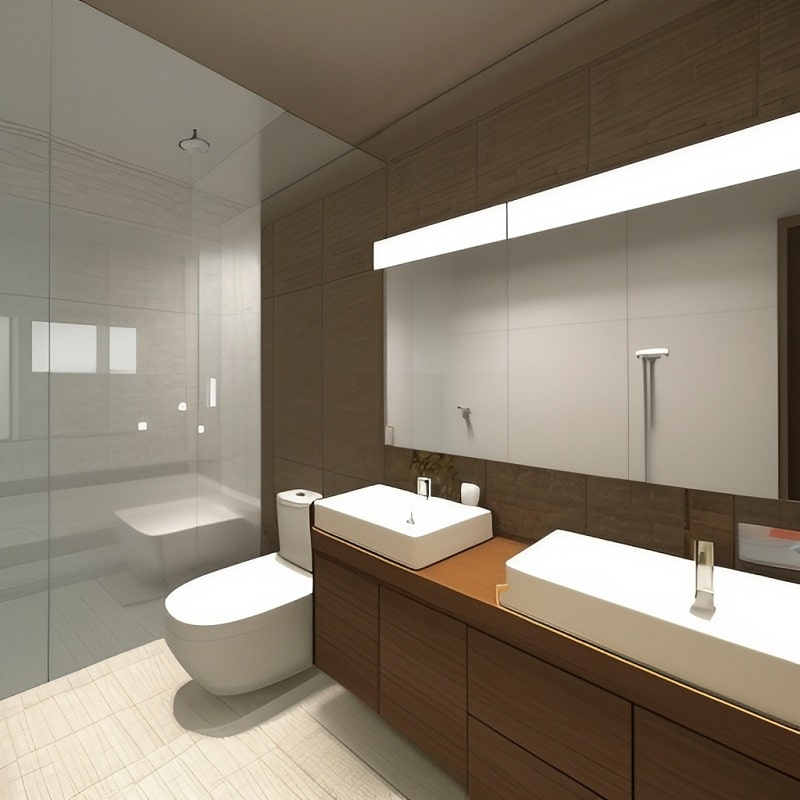
Here are some general remodel tips to ensure your next remodel goes more smoothly:
There are many elements of your remodel that cannot be fulfilled on your own. However, there are some things such as painting, flooring, and some fixtures that you can install on your own. If you feel confident, DIY as much of the bathroom as possible before a contractor comes and completes it.
The right material will always be a balance between aesthetics, function, and price. When choosing the material for your bathroom, always keep a mind on this balance and try not to go over budget or too cheap. Finding the right balance is important otherwise you may have to replace the material more often than you’d like.
If you can avoid it, try not to move your existing plumbing setup. If you have to, this can add additional costs to your remodel as a plumber will need to setup new lines to accommodate your desired setup.
Storage will always be an integral part of your bathroom, so add as much as you can. Use recessed walls, add shelves, create niches, and do whatever is possible to add storage to your bathroom. The more storage you add to the space, the less cramped it will feel.
Use wainscot beadboards to create an antique look and also protect the lower section of your walls from added moisture or water. If you don’t like the beadboard look, you can accomplish the same with tile, so long as you create a barrier between water and your wall.
It can be intimidating to remodel your bathroom, but rest assured that with proper planning, it is very straightforward. So contact your nearest contractor and transform your space into
| Category | DIY Remodel | Professional Remodel |
| Estimated Cost | $6,000 – $10,000 | $12,000 – $20,000+ |
| Labor Costs | Minimal (your time) | Typically $4,000 – $8,000 |
| Timeline | 3–6+ weeks (nights/weekends) | 1–3 weeks (dedicated crew) |
| Common Tasks You Can DIY | – Painting – Flooring (vinyl/tile) – Sink/toilet install – Light fixture swaps – Vanity replacement | N/A – all work handled by licensed trades |
| Tasks Best Left to Pros | – Plumbing or drain relocation – Electrical rewiring – Custom showers or tiling – Permitting & inspections | Included: plumbing, electrical, ventilation, waterproofing, and all structural changes |
| Permit Handling | You handle permits (if needed) | Contractor typically pulls all required permits |
| Risk | Higher if inexperienced (may void warranties or result in rework) | Lower – insured, code-compliant, and backed by warranty |
| Result Quality | Depends on skill level and time investment | High-quality, consistent, professional finish |
| ROI Potential | Higher if done well (cost-effective) | Reliable resale value, higher buyer appeal |
Remodeling a 5×10 bathroom offers two main paths: a DIY approach, which can cost between $6,000 and $10,000, or a professional remodel, which typically ranges from $12,000 to $20,000 or more. DIYers can save significantly on labor by handling painting, fixtures, and basic installations themselves, but should leave complex plumbing, electrical, and structural work to professionals. Hiring experts ensures compliance with codes, faster turnaround, and a polished finish—though it comes with a higher upfront investment. Your choice depends on your budget, timeline, and comfort level with hands-on work.
A 5×10 bathroom remodel remains one of the most impactful home improvement projects you can take. Whether you opt for a cost-saving DIY route or invest in a professionally managed renovation, upgrading a 50-square-foot space can dramatically enhance daily comfort, improve functionality, and increase your home’s resale value by $13,000 to $20,000 on average. By understanding the components, costs, and decisions involved, you can create a bathroom that balances design, durability, and return on investment—turning a basic space into a standout feature of your home.

Eric is the founder and president of Badeloft USA. He has been the president of Badeloft’s US division for over ten years and oversees all marketing and branding aspects of Badeloftusa.com.
His expertise lies in small business development, sales, and home and bathroom industry trends and information.
Contact us with any business related inquiries.
Badeloft is dedicated to helping homeowners make informed decisions about their bathrooms. We adhere to strict editorial guidelines to ensure our content is accurate, trustworthy, and useful.
Request free stone resin and stainless steel material samples. Delivered to your door.
Spring is when most bathroom remodels get serious. The weather breaks, contractors open up, and that upgrade you have been
A Japanese soaking tub, known traditionally as an ofuro, is designed for one purpose: full-body immersion. Unlike Western bathtubs built
Spring is peak bathroom renovation season – and with remodel costs up 15–20% this year, the pressure to get it
It’s spring, tax refunds are landing, and if you’ve been putting off a bathroom upgrade, you’re in good company. A
Request your free material sample below. By submitting, you agree to receive occasional product updates and offers from Badeloft. Unsubscribe anytime.
"*" indicates required fields