
Choosing a Bathtub for Two: Sizes, Features, Installation & Other Considerations Before You Purchase
There’s a gap between what a freestanding bathtub listing tells you and what it actually feels like to share one.
There’s a gap between what a freestanding bathtub listing tells you and what it actually feels like to share one. That gap has cost more than a few couples real money, and it’s the reason this guide exists.
Badeloft has been manufacturing stone resin freestanding tubs for more than a decade. We know what a 70-inch tub looks like on a product page, and we know what two people feel like inside one. Those two things are not always the same.
Both the technical details (interior dimensions, material heat retention, structural floor load) and the more experiential questions (how two bodies actually fit, what makes shared soaking feel spacious rather than negotiated) get covered here in full.
If you’ve been scrolling through listings and noticed that every tub claims to “fit two” without ever explaining what that means, this guide is for you. Maybe you’re mid-renovation, spending real money on something that needs to last decades, and you want to get the decision right the first time. Or you’ve had the experience of a tub that photographed beautifully and arrived narrower than expected.
By the end, you’ll have a clear framework for measuring interior soaking area rather than trusting exterior length, an honest look at which materials matter most for shared soaking, and a curated guide to which Badeloft models are genuinely sized for two people. The longer outcome: a tub both of you actually use for years, not one that becomes decorative.
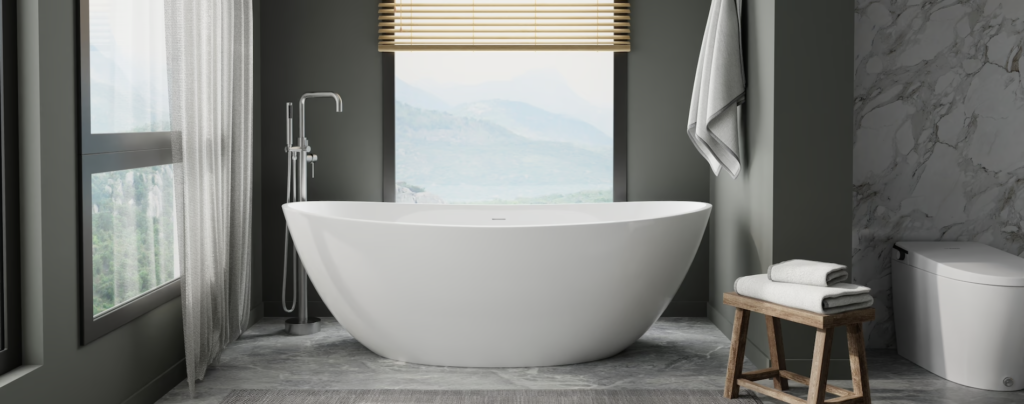
We’ll cover what “fits two” actually means in spec terms, how to size a tub for real comfort, which materials perform best when two people are soaking together, the features worth paying for, the genuine benefits of choosing a two-person freestanding tub, what to consider before you commit, and a look at Badeloft’s two-person recommendations.
So, let’s start with the spec that almost no product page explains — the one that determines everything else about whether a tub is actually big enough for two.
Every bathtub listing leads with three numbers: length, width, and height. Those numbers represent the exterior shell. They tell you how much floor space the tub occupies. They do not tell you how much soaking room the people inside it actually have.
The interior soaking area is always smaller than the exterior. For acrylic tubs, wall thickness typically runs between a half-inch and an inch per side. For stone resin tubs, the shell is typically 1 to 1.5 inches thick on each side. That alone removes 2 to 3 inches from the interior length and a similar amount from the interior width. Slope at the foot end, backrest angle, and rim overhang take additional space. A tub listed at 70 inches often provides 63 to 65 inches of interior soaking length.
For one person, this difference rarely matters. For two people, it changes everything.
Two adults soaking in the same tub in the most common configuration — facing each other from opposite ends — need enough interior length for both sets of legs to extend without constant adjustment. For average-height adults (around 5’6″ to 5’10”), that threshold is roughly 64 to 66 inches of interior soaking length. Taller adults push that closer to 68 inches.
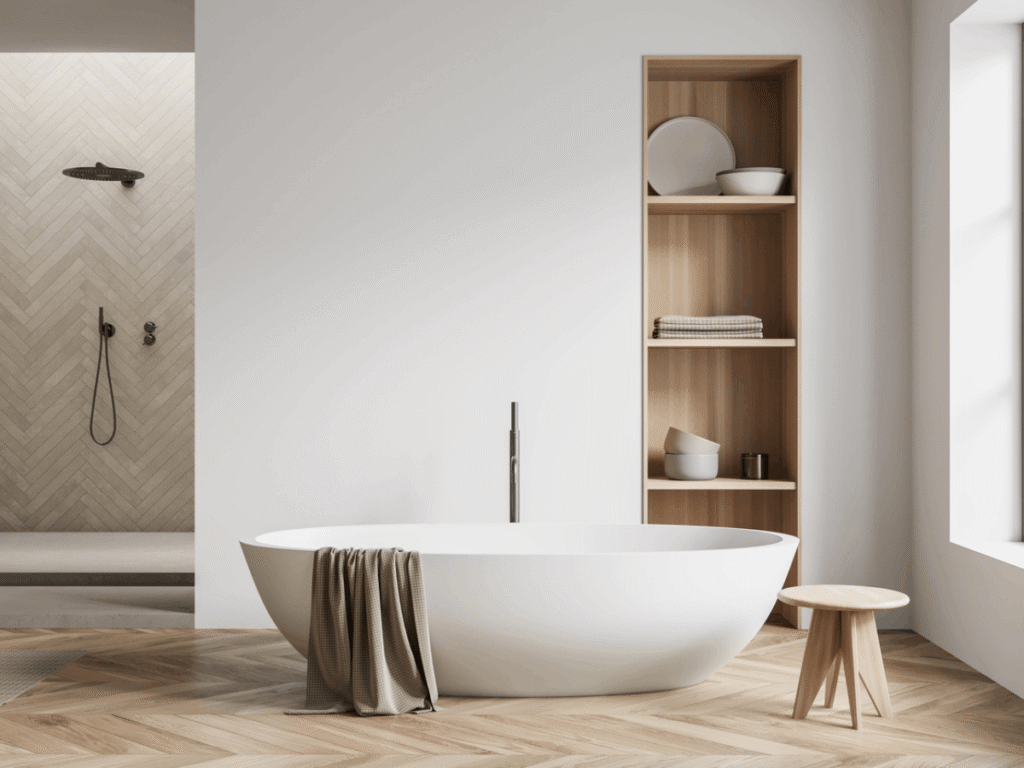
Drain placement reveals how a tub was designed. In a true two-person freestanding tub, the drain sits at the center of the tub floor, or the tub includes two foot wells of equal depth. When the drain is at one end, one person gets a comfortable foot well and the other is resting their feet directly over the drain opening. This detail doesn’t appear prominently on any product page, but it becomes an obvious irritant once you’re in the water.
When evaluating any two-person tub, ask for the interior soaking dimensions, not the exterior shell size. The internal length, internal width at the widest soaking point, and soaking depth are the numbers that determine whether the tub actually works for two.
The bathtub industry uses “small,” “medium,” and “large” as loosely defined categories. Here’s a more useful way to think about the size ranges when two adults are the primary users:
| Size Category | Exterior Length | Approx. Interior Soaking Length | Two-Person Reality |
|---|---|---|---|
| Small | 61–63″ | ~55–57″ | Designed for one. Two adults are sharing space, not soaking. |
| Medium | 66–70″ | ~60–65″ | Comfortable for two average-height adults facing each other. Tight for taller or broader builds. |
| Large | 71–75″ | ~65–69″ | Genuinely comfortable for two adults. The right range for most couples. |
| Extra-Wide | 70″+ with 35″+ width | Varies | Opens up true side-by-side soaking. Requires significantly more bathroom floor space. |
Width matters more than most buyers anticipate. The interior width at the soaking zone determines whether two adults can sit comfortably side by side or whether the facing configuration is the only workable option. Most two-person tubs in the 70-inch length range have interior widths of 28 to 32 inches, which supports the facing configuration well. An interior width approaching 36 to 40 inches opens up true side-by-side bathing.
Then there’s the weight question, and this one has structural implications.
A stone resin tub in the 70-inch range weighs roughly 250 to 300 pounds empty. Filled to soaking level, water adds approximately 500 to 580 pounds (a 70-gallon capacity at 8.34 lbs per gallon). Two adults add another 300 to 400 pounds. The realistic fully-loaded weight of a large two-person stone resin tub sits between 1,000 and 1,200 pounds. Residential floors in wood-frame construction are typically engineered to hold 40 pounds per square foot. A large tub concentrates significant weight over a relatively small floor area.
Before installing any large freestanding tub, a structural assessment of the subfloor is worth doing. A licensed contractor or structural engineer can confirm whether reinforcement is needed before the tub goes in. This step gets skipped often, and it’s the one that homeowners later wish they hadn’t skipped.
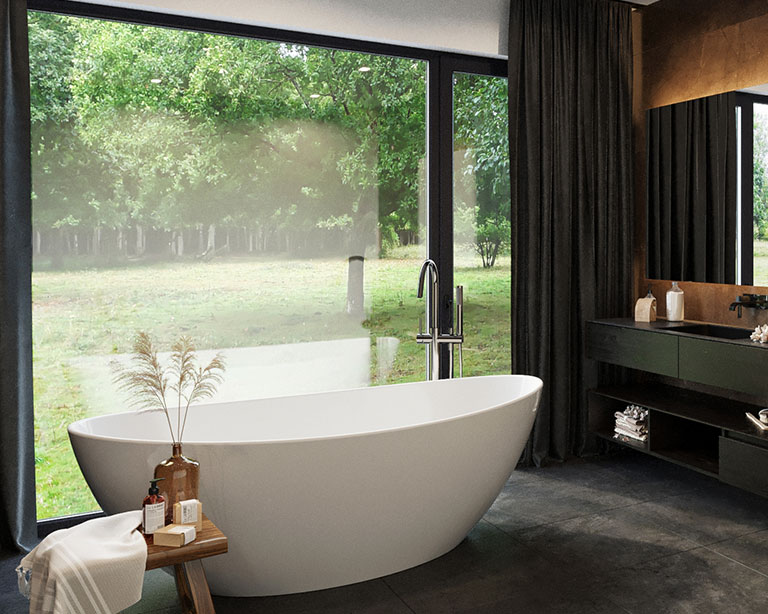
Material choice has more impact on a shared soaking experience than almost any individual feature. The reason is straightforward: two people in a tub increase the water surface exposed to air, which accelerates heat loss. Both of you notice when the water starts cooling down.
Stone resin is Badeloft’s material, and we’ll be direct about why we chose it and where it genuinely outperforms the alternatives.
Stone resin is a composite of natural stone aggregate bound with resin, cast to a uniform shell thickness of 1 to 1.5 inches. That thickness functions as a thermal buffer. The shell absorbs heat from the water and radiates it back rather than losing it to the surrounding air. Water in a stone resin tub cools approximately 5 to 7 degrees Fahrenheit over 50 minutes, compared to 12 to 15 degrees in a standard acrylic tub under similar conditions. For two people planning to soak for 30 to 45 minutes without running the hot tap repeatedly, that’s a meaningful difference in practice.
Stone resin is non-porous, which means it doesn’t absorb bath oils, salts, or additives over time. Cleaning is straightforward: warm water and a soft cloth. No annual sealing, no special coating, no maintenance schedule to keep.
Acrylic is the most common alternative. It’s lighter (which simplifies installation), available at a lower price point, and produced in a wide range of shapes. The trade-off is wall thickness, typically 3 to 8mm for vacuum-formed acrylic, which provides limited thermal insulation. Some acrylic tubs include spray foam insulation bonded to the underside of the shell, which improves heat retention noticeably but doesn’t match the thermal mass of a stone resin shell. If acrylic is the right material for your budget or weight requirements, look specifically for insulated acrylic rather than uninsulated.
Copper and natural stone are worth acknowledging. Copper conducts heat excellently and has natural antimicrobial properties, but custom copper tubs come with a high price, significant weight, and maintenance requirements specific to the metal’s patination over time. Natural stone (granite, marble, slate) offers exceptional durability and visual impact but is priced beyond most residential renovation budgets and adds floor-load challenges beyond even stone resin.
For a two-person freestanding tub that will be used regularly over many years, stone resin is the material that performs consistently across heat retention, durability, surface quality, and longevity. That’s the honest conclusion, even accounting for the fact that it’s what we make.
Feature lists on tub product pages tend to be long. Most features make a minor difference to the experience. A few make a significant difference when two people are using the tub regularly.
A double-ended tub has a backrest slope at both ends. Both bathers can recline in a supported, comfortable position. A single-slipper design gives one person a fully elevated backrest and the other a flat or minimally angled foot end. For occasional use, this is manageable. For couples who intend to use the tub together regularly, a double-ended design is the right choice. It communicates, in the design itself, that both people were considered.
Center drain placement means equal foot well depth for both bathers. A side-mounted overflow (rather than end-mounted) also distributes the interior layout more evenly. These details are rarely called out prominently on product pages, but they’re worth checking before you order.
Whirlpool jets are typically positioned for one primary user. The jet inlets tend to sit at one side or end of the tub, delivering targeted massage to whoever is nearest. Air jets, which release thousands of small bubbles through the tub floor and walls, distribute more evenly across the interior and serve both bathers without a dominant and secondary position. That said, many couples find that the heat retention and soaking depth of a quality stone resin tub is the core experience; the jets are a supplement, not the reason to buy. Jets are standard to whirlpool based bathtubs, these features do not usually come with your standard soaking bathtubs.
A floor-mount faucet positioned at the center-side of the tub, or deck-mounted on the rim at the midpoint, gives both bathers access to temperature controls. An end-mounted faucet hands control to one person and requires the other to lean or ask every time they want to adjust. For a shared-use tub, faucet placement is a small decision with a daily impact.
Some higher-end tub systems include programmable shell heating or in-line water heaters that maintain temperature automatically. For couples who treat the tub as a regular wellness practice rather than an occasional use, this is worth considering. It removes the variable of cooling water mid-soak and makes the experience repeatable rather than managed.
The benefits of choosing a larger, two-person freestanding tub are real. We’ve covered them in earlier buying guides, and we’re including them here because this is now the consolidated guide on the topic. The difference is that we’ve earned the right to discuss the benefits by first being honest about what the specs mean and where the common mistakes happen.
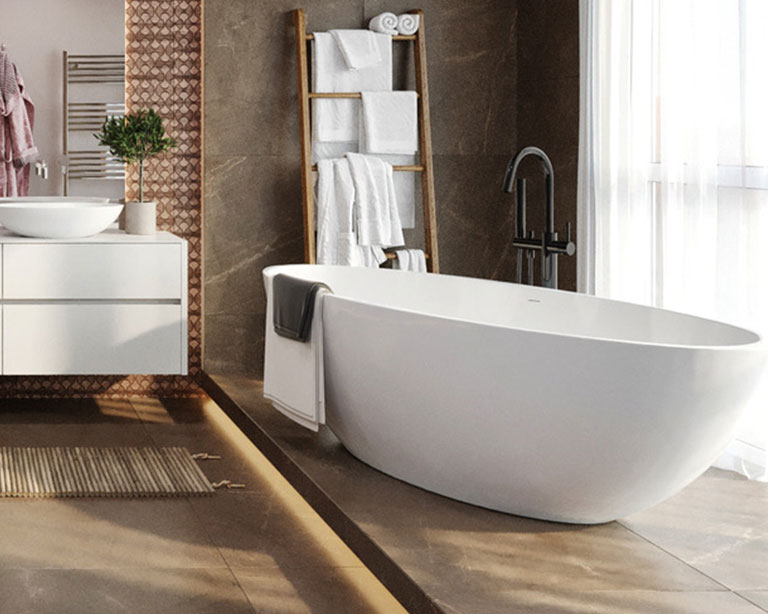
There’s something that changes in how couples relate to a room when it’s genuinely designed for two. A bathroom with a single-person tub is a practical space. A bathroom with a well-proportioned two-person freestanding tub becomes a place couples actually spend time in together. For couples who use the tub for post-exercise recovery, stress decompression, or hydrotherapy, the shared experience amplifies the benefit. Warm water lowers cortisol and reduces muscle tension. Sharing an unhurried hour in a tub where both of you are comfortable is a different kind of rest than two people taking sequential solo baths.
A two-person tub doesn’t remain a “couples tub” for its entire lifespan. For families with young children, the same tub that accommodates two adults becomes the space where a parent and two small children fit without chaos. For households with elderly relatives or anyone recovering from injury, the larger footprint and stable interior give more room to manage entry and exit safely. Optional guide rails position more effectively on a larger tub. The investment scales with the household in a way that a smaller, single-person tub simply doesn’t.
The National Association of Home Builders consistently identifies freestanding bathtubs as a feature that influences buyer decisions at the luxury end of the residential market. A well-chosen, well-installed two-person freestanding tub reads as an intentional design decision to anyone who walks into the bathroom. At resale, buyers who are looking for a home they don’t have to immediately renovate respond to those signals.
The figure cited across industry sources, that you can expect to recoup at least 60 percent of the investment in a quality bathroom tub at resale, is a reasonable reference point. The larger variable is the quality of the tub and the installation. A high-quality stone resin tub, properly installed in a well-designed bathroom, holds its value. A cheaper tub that shows wear, yellowing, or surface damage within the first decade does not.
A two-person freestanding tub gives both bathers more room to manage entry and exit safely. The larger interior means the walls sit at a more manageable step-over height relative to floor clearance, and the width gives more room to stabilize on the way in and out. For households where one partner has limited mobility or is recovering from surgery, the additional interior space matters in ways that go beyond comfort into practical necessity.
The primary users and their dimensions should drive the size decision. Two people at 5’6″ and 5’8″ have different requirements than a couple where one partner is 6’2″. A practical calculation: take the taller partner’s height, subtract a few inches for comfortable bend in the knees, and that’s the minimum interior soaking length you need for one person. For a facing configuration, both people’s measurements need to fit within the interior length with comfortable clearance, not just technical fit. Run this calculation before you look at any model.
Freestanding tubs require a licensed plumber for drain and supply line connections, and most installations involve two to three people for the physical placement of the tub. Before installation begins, a structural assessment of the subfloor confirms whether reinforcement is needed. This step gets skipped regularly and tends to create problems that are expensive to address after the tub is already in. The plumber and the contractor need to coordinate on drain placement before the tub is positioned, because adjusting after the fact is a much larger project than coordinating before.
Unlike drop-in tubs that require a built surround, freestanding tubs have flexibility in placement. The drain connection needs to be reachable from existing plumbing, but the tub itself can float in the room, anchor a wall, or center a window without being built into anything.
Stone resin requires minimal maintenance. Warm water and a soft cloth handle routine cleaning. Avoid abrasive cleansers and harsh chemicals, which can dull the surface finish over time. A periodic wipe-down with a gentle stone-safe cleaner keeps the surface looking new indefinitely. No annual sealing and no maintenance schedule.
Acrylic is equally straightforward to clean but can scratch under abrasive cleansers and may yellow with prolonged UV exposure or certain cleaning chemicals. Quality acrylic with a protective gel coat is more durable than basic vacuum-formed acrylic; this distinction is worth asking about when comparing acrylic tubs.
At the price point where a two-person freestanding tub sits, testing the fit in person before ordering is worth the trip. Most Badeloft dealers have showroom models. Bring your partner, and actually get in the tub. Test the backrest angles in both the reclining and sitting positions. Bring a measuring tape and verify the interior soaking length yourself, not just the exterior. Check where the drain sits relative to both foot wells. The 20 minutes you spend in a showroom is a small investment against a decision that will be in your bathroom for two decades.
Every Badeloft tub is made from stone resin. The difference between models is geometry: length, width, soaking depth, and profile shape. For two-person use, we’d point most buyers toward five models based on interior proportions, double-ended configuration, and the practical balance between size and bathroom footprint.
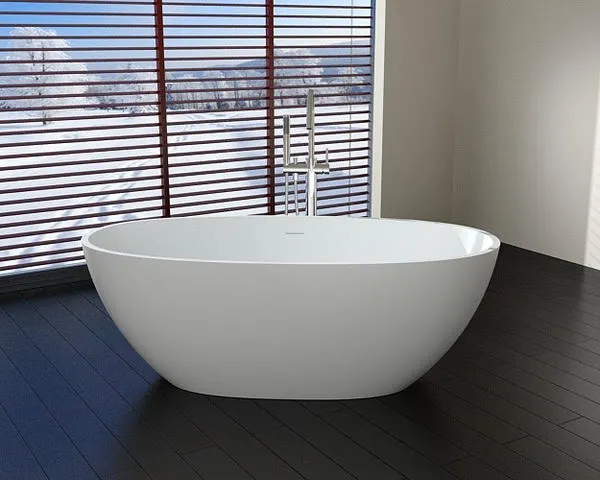
This is the one model in our lineup explicitly designed for side-by-side soaking. At 47.2 inches wide, it’s the only Badeloft tub where two adults can soak shoulder-to-shoulder without compromise. The 74.8-inch length gives enough room for both people to extend their legs fully in the side-by-side configuration. This tub requires a larger bathroom footprint and a confirmed structural assessment before installation, but for couples who want a genuine side-by-side experience, it’s the right choice. There’s nothing else in our catalog like it for that specific use case.
The BW-11 has the best width-to-length ratio of any mid-size model in our range for two-person use. At 35.8 inches wide, it provides notably more shoulder clearance than the narrower oval profiles, and the 68.9-inch length comfortably accommodates two adults of average height in the facing configuration. The 22-inch soaking height is deep enough for full-body immersion without making entry difficult. This is the model we’d suggest for couples who want a genuinely spacious shared tub without the floor space commitment of the XXL.
The BW-03-XL is the deepest soaking tub in this group at 24.4 inches. For couples who prioritize full-body immersion above other factors, that extra depth is meaningful, particularly for hydrotherapy and muscle recovery use. The 70.8-inch length and 35.4-inch width support comfortable two-person facing use. The higher soaking depth does mean the step-over entry height is greater, which is worth considering for any household member with limited mobility.
The BW-05-XL shares the 35.4-inch width of the BW-03-XL with a lower profile at 22.5 inches. Entry and exit are easier while the interior soaking area remains the same. For couples looking for the same two-person proportions with more accessible entry, this is the direct comparison to make against the BW-03-XL. The choice between them comes down to how much you value soaking depth versus ease of getting in and out.
The classic oval profile at 72.8 inches gives two adults of average to above-average height the interior soaking length they need for the facing configuration. The 32.7-inch width is narrower than the BW-11 and BW-03-XL, which makes this the right model for couples who prefer the traditional freestanding tub silhouette and are not planning side-by-side use. At the interior length this model provides, the narrower width is a design preference, not a practical limitation.
The most common mistake in choosing a two-person bathtub is trusting exterior dimensions and resolving the rest later. The rest tends to matter more than the number on the listing.
Here’s the order that produces the best outcome:
If you’re moving toward a Badeloft stone resin tub, our team can help with specific model questions, exact interior dimensions, and guidance on which configuration fits your bathroom layout. Every model can be viewed and tested at authorized dealers. We’d rather you get in the tub before you decide than find out after delivery that you need something different.
A two-person freestanding tub bought well is a fixture you use for 20 years. Bought without the right information, it’s an expensive reminder that the numbers on a product page aren’t the same thing as comfort in a bathroom. That’s the gap this guide was written to close.

Eric is the founder and president of Badeloft USA. He has been the president of Badeloft’s US division for over ten years and oversees all marketing and branding aspects of Badeloftusa.com.
His expertise lies in small business development, sales, and home and bathroom industry trends and information.
Contact us with any business related inquiries.
Badeloft is dedicated to helping homeowners make informed decisions about their bathrooms. We adhere to strict editorial guidelines to ensure our content is accurate, trustworthy, and useful.
Request free stone resin and stainless steel material samples. Delivered to your door.
There’s a gap between what a freestanding bathtub listing tells you and what it actually feels like to share one.
The bathtub you choose will shape how you use your primary bathroom every day for the next two decades. Not
A freestanding bathtub is the most permanent aesthetic decision in a bathroom renovation. Get the selection right and it becomes
Choosing the right bathtub drain stopper is essential for creating a comfortable and functional bathing experience. With over 20 common
Request your free material sample below. By submitting, you agree to receive occasional product updates and offers from Badeloft. Unsubscribe anytime.
"*" indicates required fields